
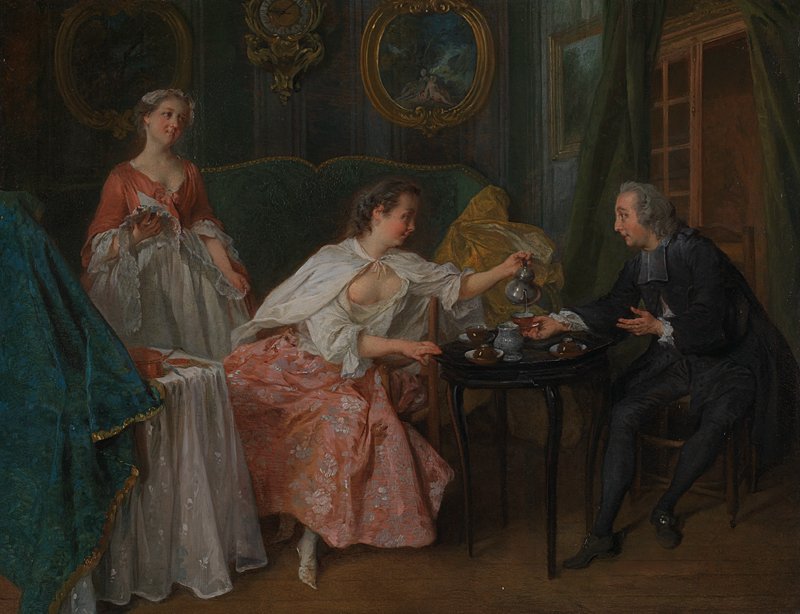
Introduced to Europe in the 17th century, tea became one of the favorite hot beverages of Enlightenment-era aristocracy. At the crossroads of exoticism and Anglomania, it emerged in France as a defining marker of elite society and a central element of aristocratic sociability.
OA 10658)
© 1998 GrandPalaisRmn (musée du Louvre) / Daniel Arnaudet
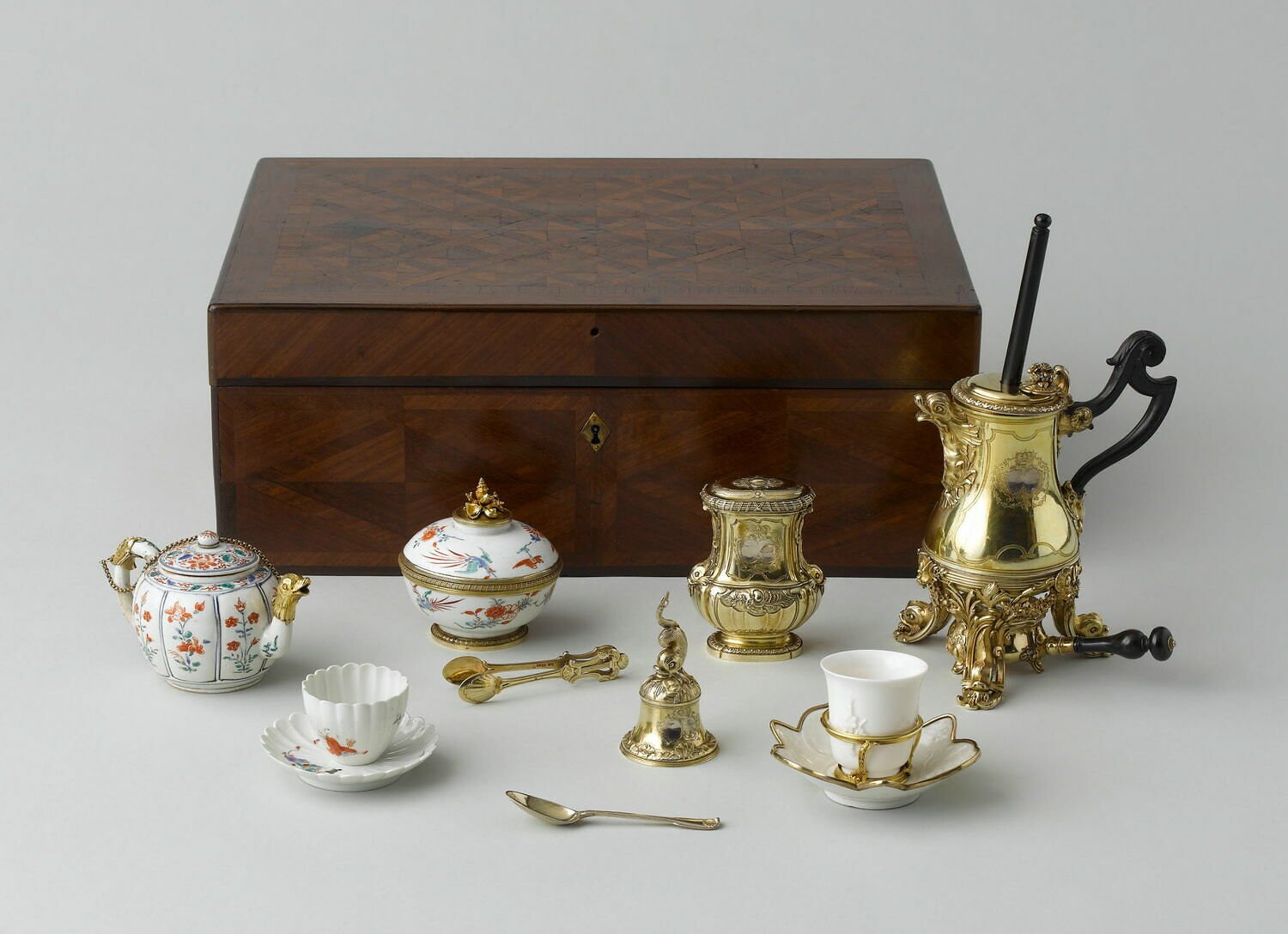
Consumed in China and Japan since antiquity, tea first reached Europe in the first half of the 17th century. Imported by the Dutch and English East India Companies, it quickly gained popularity in both countries as well as in Paris. In 1687, Nicolas de Blégny, physician to the king, described in his treatise The Proper Use of Tea, Coffee, and Chocolate the supposed medicinal virtues of tea and the correct way to prepare it. Aboard East India Company ships, cups, saucers, and teapots traveled alongside cargoes of tea from Asia. Once in Paris, they adorned refined tables and were used interchangeably for tea, coffee, or chocolate. The travel set presented by Louis XV to his wife, Queen Marie Leszczyńska, for the birth of the Dauphin in 1729 included a sugar bowl and a Japanese porcelain teapot, small Chinese porcelain cups mounted in trembleuses, a tea caddy and strainer in vermeil, as well as a chocolate pot and a coffee pot.
© 2008 GrandPalaisRmn (musée du Louvre) / Jean-Gilles Berizzi
Particularly costly, tea consumption in France was initially reserved for the highest levels of aristocracy, among whom it spread during the second half of the 18th century. Combining exotic appeal with new flavors, it first reflected a growing fascination with China—its economy and culture. In 1761, Queen Marie Leszczyńska dedicated the decorative program of her Cabinet des Chinois at Versailles to the tea trade. From the 1760s onward, under the influence of Anglomania, tea—once confined to private settings—became an essential moment of aristocratic sociability. The Prince de Conti commissioned Michel-Barthélemy Ollivier to paint one of his favorite pastimes, Tea in the English Style Served in the Salon des Quatre-Glaces at the Temple. The distinguished guests serve themselves the precious beverage. Among them, one can even recognize the young Mozart seated at the harpsichord, performing for the prince in 1764. Served with milk, cream, or sugar, and often accompanied by cakes or bread, tea became a hallmark of refined aristocratic life.
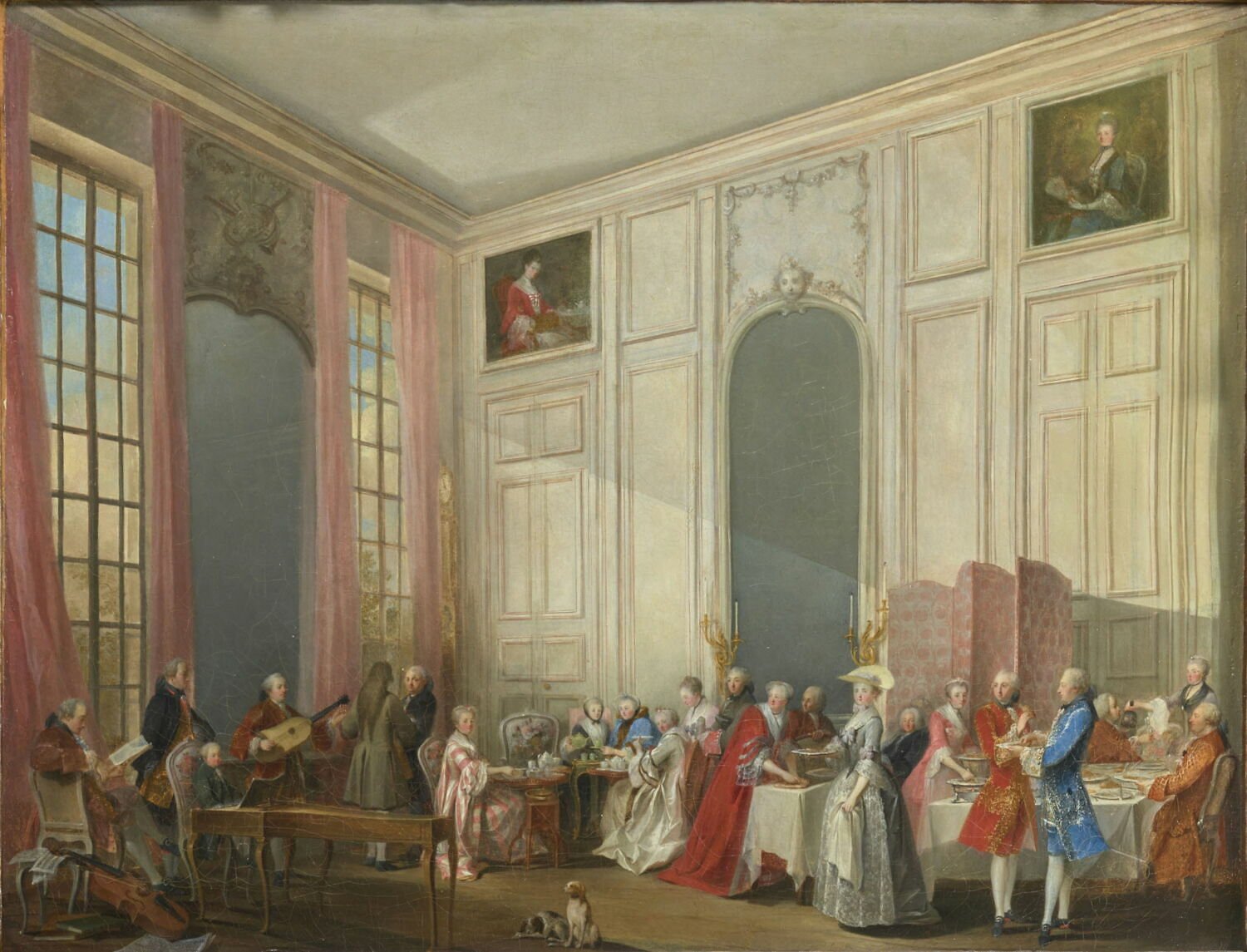
[An English-style tea party served in the Salon des Quatre-Glaces at the Palais du Temple in Paris in 1764], 1777, commissioned for the Château de l’Isle-Adam by the Prince de Conti, Versailles, Châteaux de Versailles et de Trinaon (inv. MV3824)
© 2022 Musée du Louvre, Dist. GrandPalaisRmn / Christophe Fouin
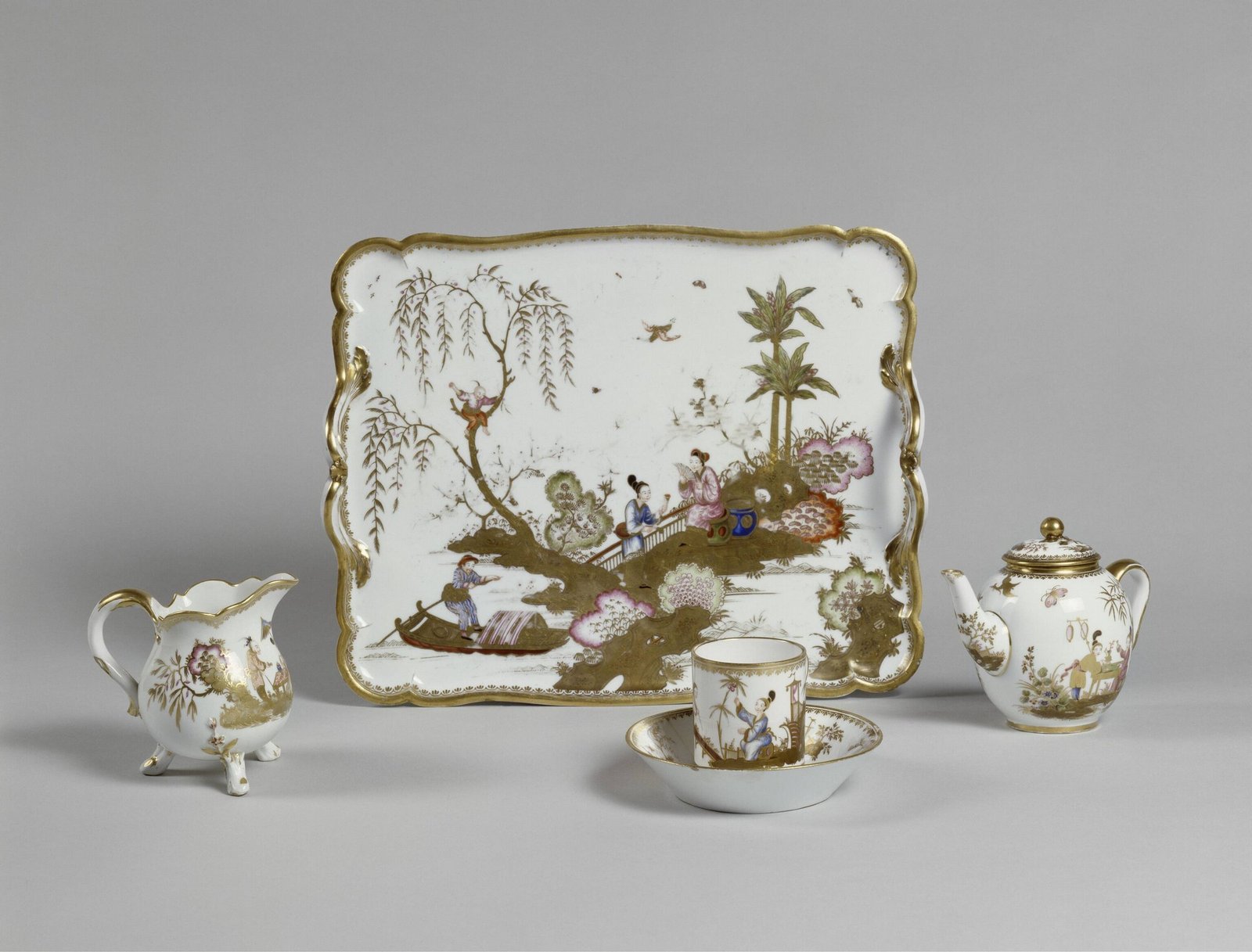
As tea consumption expanded in France, the objects associated with its preparation and service became increasingly varied and specialized. The word “théière” [teapot] itself only appears toward the end of the century—Blégny still referred to it as a “pot” or “vaisseau” in 1687. To meet growing demand for hot beverages, European porcelain manufactories, notably Meissen, Saint-Cloud, and Sèvres, competed in creativity. They produced handled cups, deep saucers, teapots, in a wide variety of forms and decorative styles. These elements could be assembled on trays into sets known as déjeuners, referring to a favored moment for tea consumption comparable to today’s breakfast. The royal family was among the main consumers of tea. In 1774, Louis-Philippe, Duc d’Orléans, acquired a Sèvres porcelain déjeuner decorated with Chinese motifs, including a reed-shaped teapot similar to one now preserved at Sèvres (inv. MNC 4670). The sovereigns, as well as Mesdames—the daughters of Louis XV—also owned precious tea services in their private apartments.
© RMN-GP (Château de Versailles) / © Gérard Blot
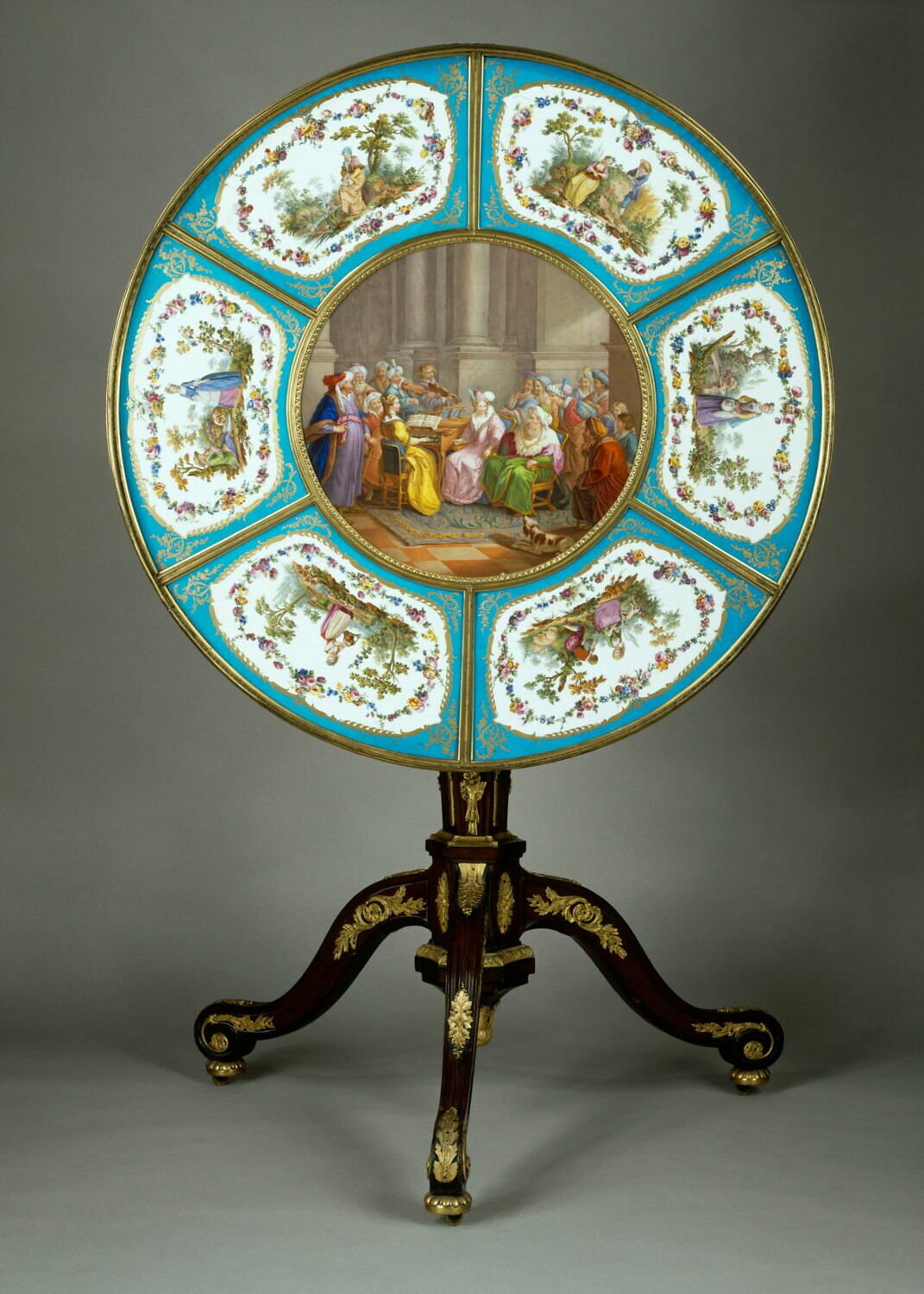
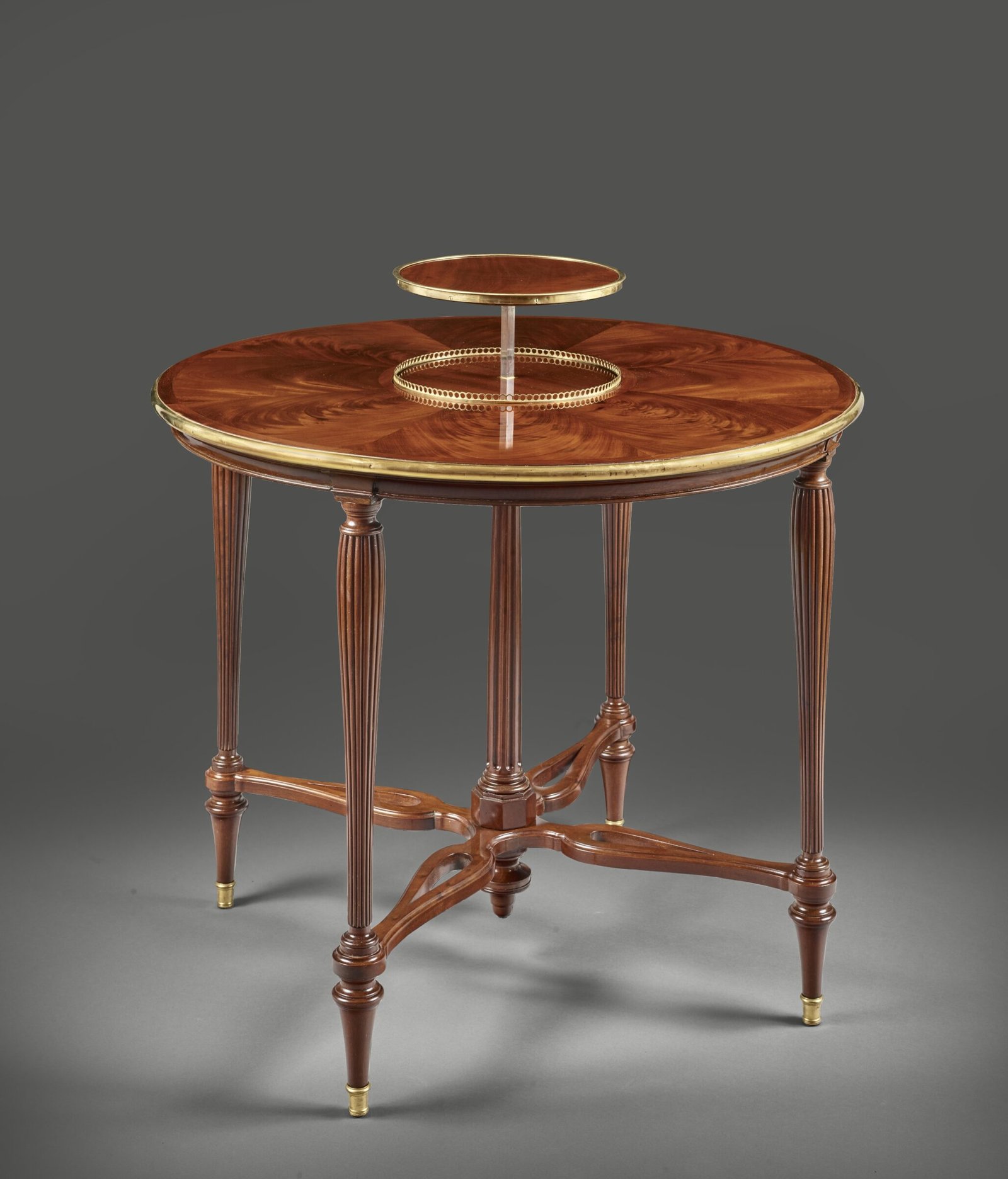
Beyond utensils and services, tea consumption gave rise to specialized furniture. Numerous tea tables and small stands were produced toward the end of the century, often reflecting English influence. Mahogany was frequently favored for these refined pieces, one of the most remarkable examples being the table made in 1774 for Madame du Barry. Adorned with seven painted Sèvres porcelain plaques, it was crafted by cabinetmaker Martin Carlin (1730–1785) under the direction of the marchand-mercier Simon-Philippe Poirier. A few years later, Adam Weisweiler (1746–1820) developed a model featuring a rack mechanism that allowed the central top to be raised, enabling guests to easily arrange and access all elements of the service. To complement this specialized furniture, a variety of small volantestables were also used.
Imported from Asia, tea profoundly transformed social customs in 18th-century France, giving rise to new rituals, objects, and forms of furniture. Initially reserved for the aristocracy, it gradually spread throughout society, ultimately becoming a daily practice that remains alive today.
Bibliography:
Ouvrage collectif, Thé, café ou chocolat ? Les boissons exotiques à Paris au XVIIIe siècle, Paris Musées, 2015
Marie-Laure de Rochebrunne (dir.), La Chine à Versailles. Art et diplomatie au XVIIIe siècle, Somogy éditions d’art, 2014
Stéphane Castelluccio, Le Goût pour les porcelaines de Chine et du Japon à Paris aux XVIIe et XVIIIe siècles, Éditions Monelle Hayot, 2013

