
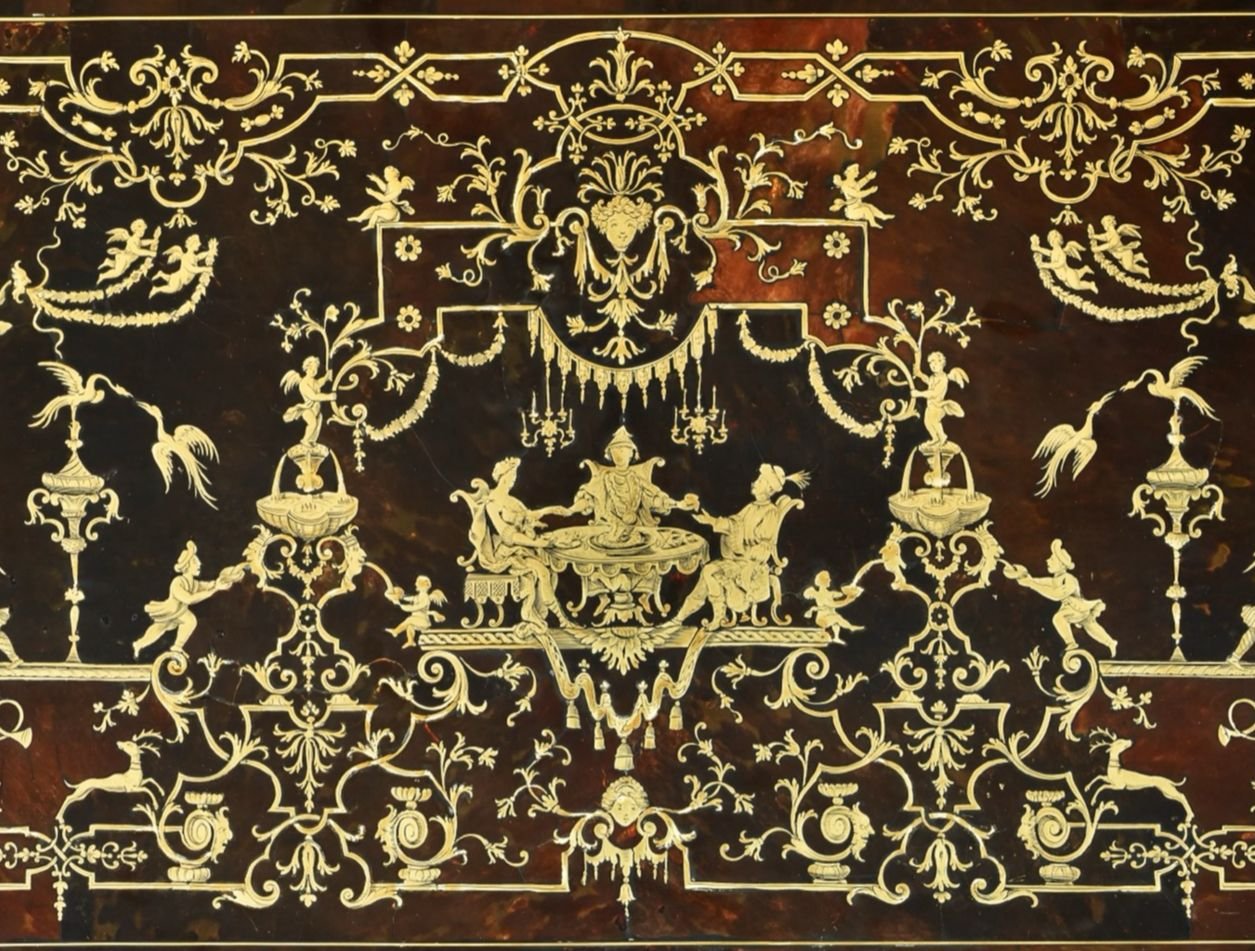
Less well known than his son, the famous “BVRB,” Bernard I Van Riesen Burgh was nonetheless one of the foremost cabinetmakers of the late reign of Louis XIV and the Régence period. His marquetry work, of exceptional richness, attracted a distinguished clientele.
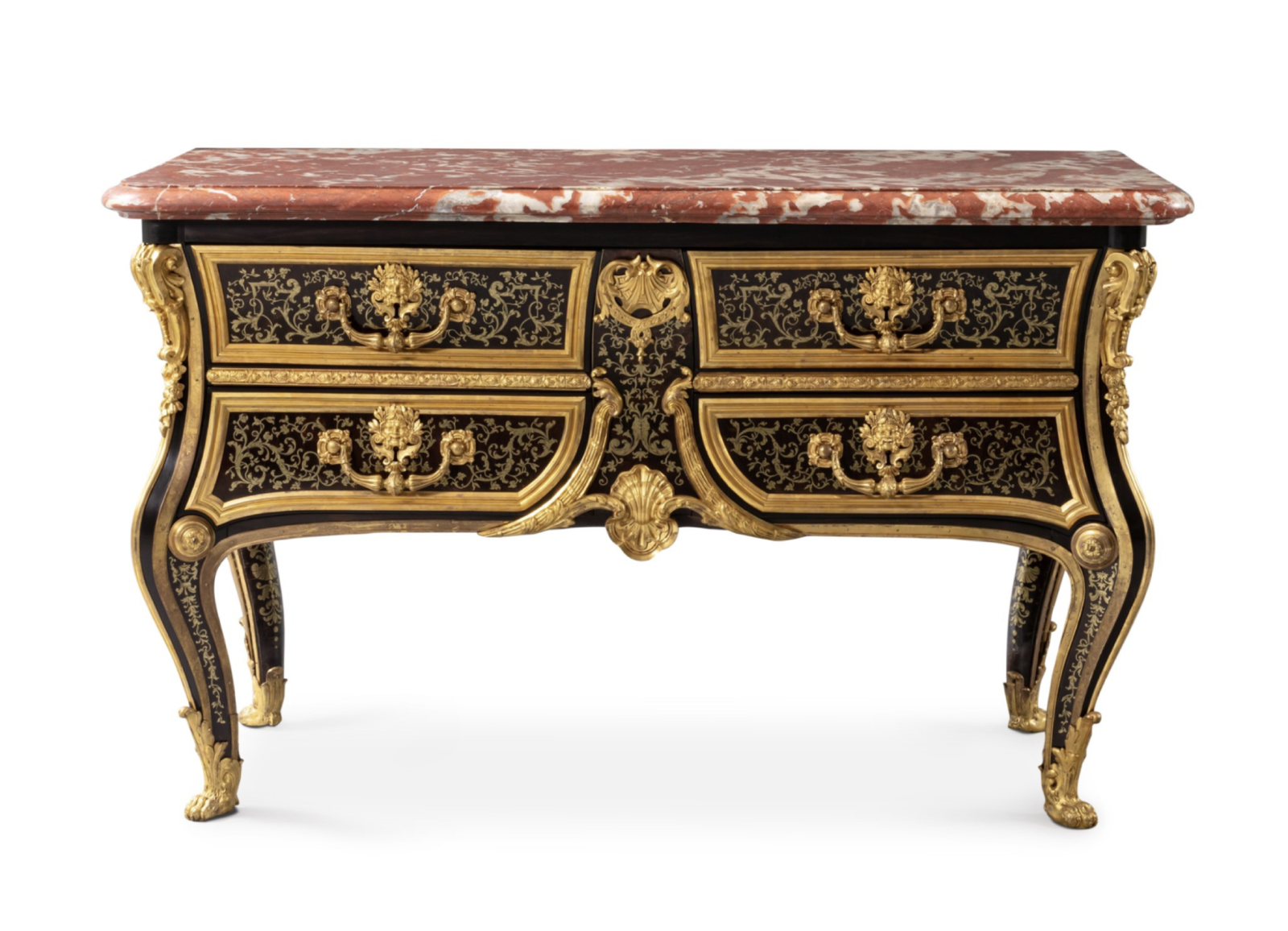
Bernard I Van Riesen Burgh was born in Groningen, in the northern Netherlands, around 1660. He came to Paris to practice the cabinetmaking trade before 1694, settling in the faubourg Saint-Antoine, a neighborhood home to many craftsmen of Dutch and Germanic origin. Initially working as a free artisan of the faubourg, he purchased his mastership in the cabinetmakers’ guild around 1710, bypassing the apprenticeship system then in use. A highly skilled craftsman, he quickly built a strong reputation and attracted a distinguished clientele. His 1738 post-mortem inventory sheds light on the state of his workshop at the close of his career: it still housed seven workbenches — an important number for his specialty — and by that point produced nothing but clock cases. The scale of his workshop is further reflected in his choice of collaborators: he appointed Adrien Dubois as workshop foreman, while the latter’s brother François served as “engraver, cutter, and marquetry worker.” His principal bronze-chaser, Louis Blondel, also worked for Antoine-Robert Gaudreaus (1680–1746) and Gilles Joubert (1689–1775), two other leading cabinetmakers of the Age of Enlightenment.
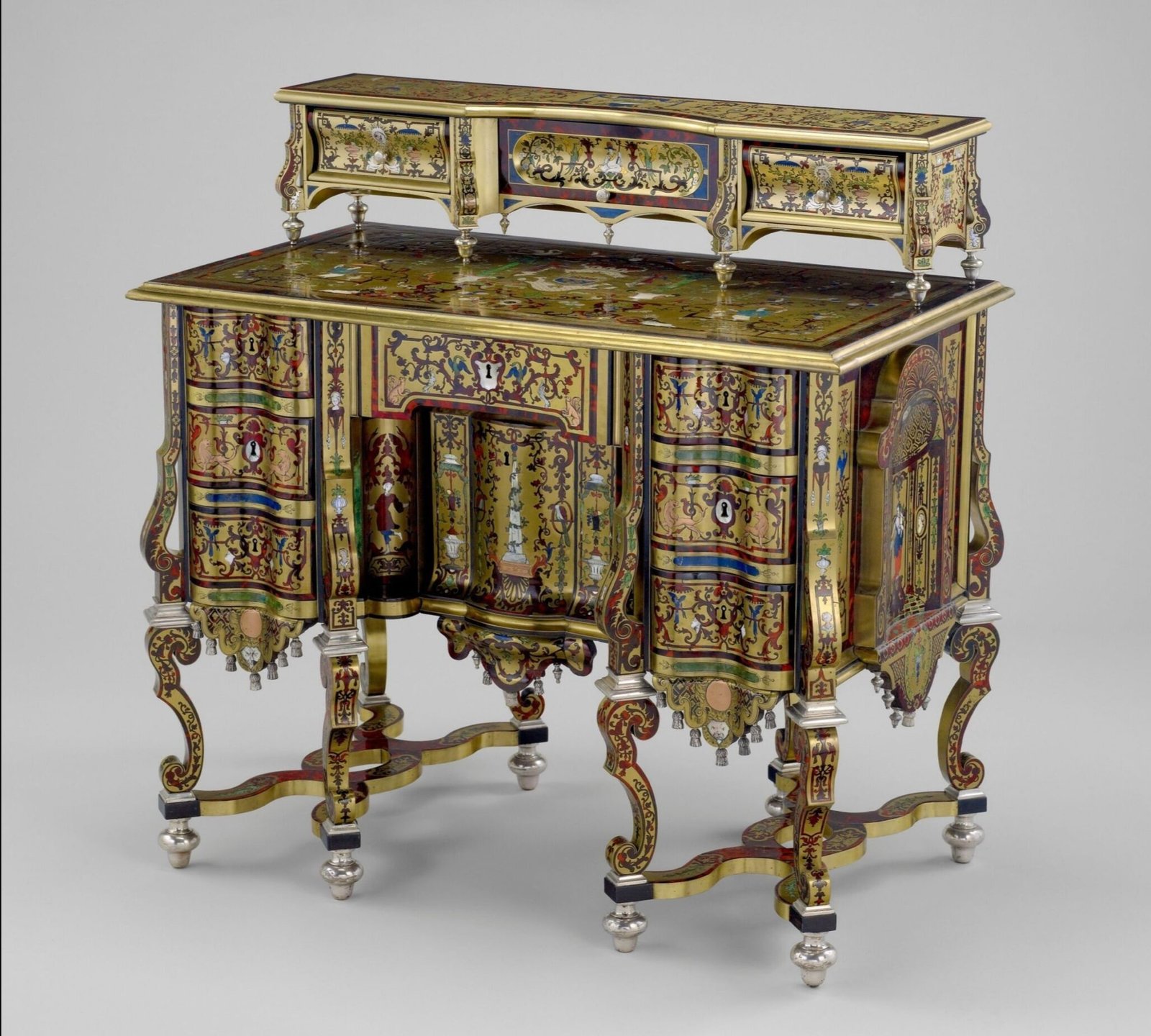
In the 1690s, Van Riesen Burgh produced exceptionally luxurious furniture in metal and tortoiseshell marquetry, frequently enhanced with mother-of-pearl and tinted horn ornaments. The desk he made for the Duchesse de Retz is a particularly fine example of this Louis XIV furniture, innovative in both its lines and its ornamentation. Its « mazarin » form had been developed only a decade earlier. The sides of the piece are adorned with original trompe-l’œil niches set in relief, while elaborate corbels punctuate each elevation. Destined for the duchess’s magnificent private mansion in the lower Marais, it must have been one of the centerpieces of what Saint-Simon described as a “fairy palace.” Van Riesen Burgh produced several pieces of the same type during this period, including a near-identical example now in the J. Paul Getty Museum, made for Maximilian II Emanuel, Elector of Bavaria.
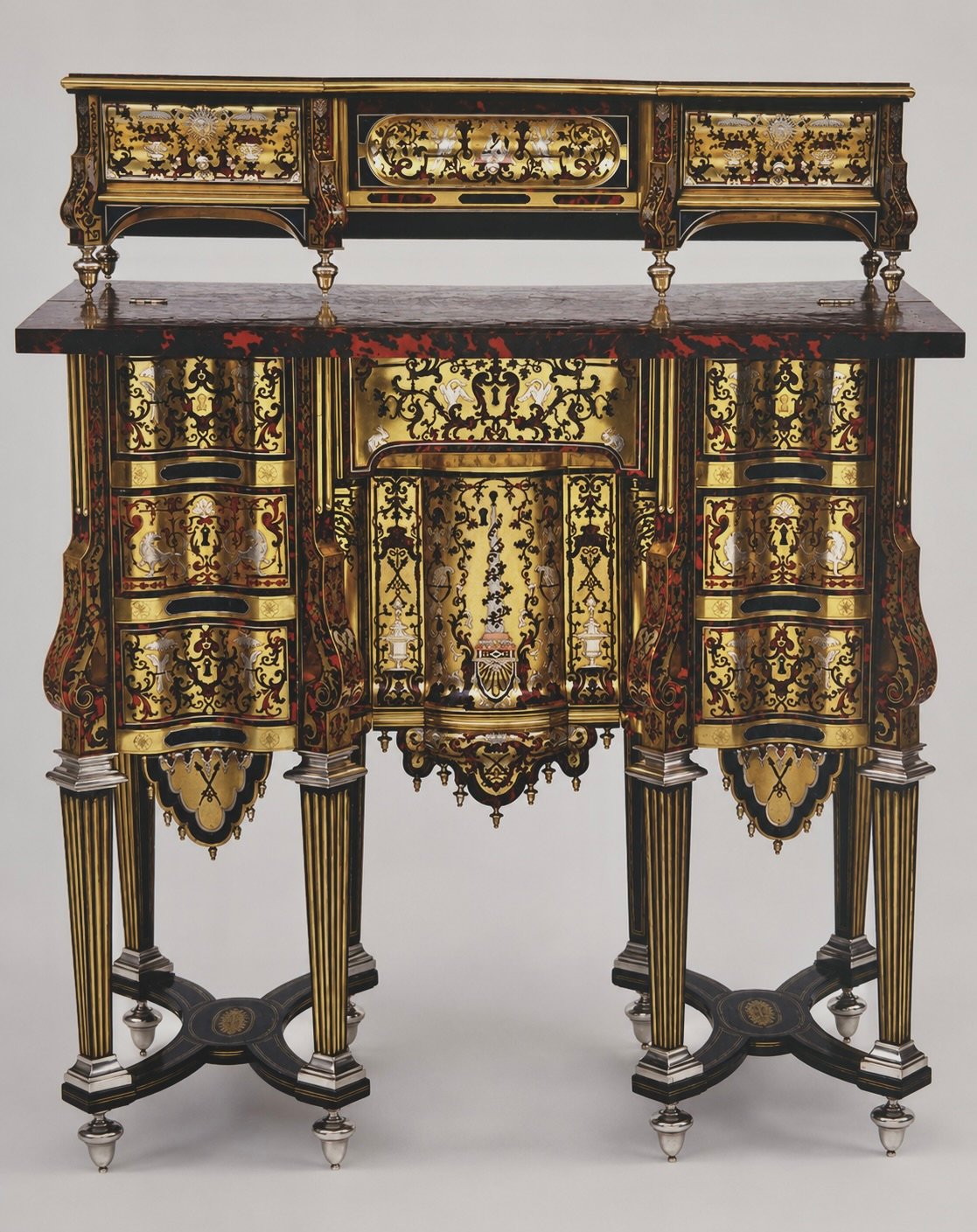
Exiled in Paris during the final years of Louis XIV’s reign, amid the War of the Spanish Succession, Maximilian II Emanuel developed a marked taste for French furniture. He placed orders with the most celebrated Parisian craftsmen through the dealer Edme Calley. Calley’s shop, Au Roy d’Espagne, on the rue de la Monnaie, was one of the most fashionable in Paris during the 1710s, drawing a wealthy clientele. Around 1714, the Elector of Bavaria commissioned an equestrian statue from Calley, the base of which was entrusted to Bernard I Van Riesen Burgh. The cabinetmaker brought a renewed aesthetic sensibility to the piece: the delicate copper marquetry on brown tortoiseshell, combined with richly gilded and finely chased bronze mounts, speaks to the emerging Régence taste. Further commissions followed, most notably the superb « à gradins » desk that brought together Sébastien Slodtz (1655–1726) for the bronzes and Van Riesen Burgh for the cabinetwork. Its highly original form and exceptional quality of execution make it one of the finest pieces from the very beginning of the Régence.
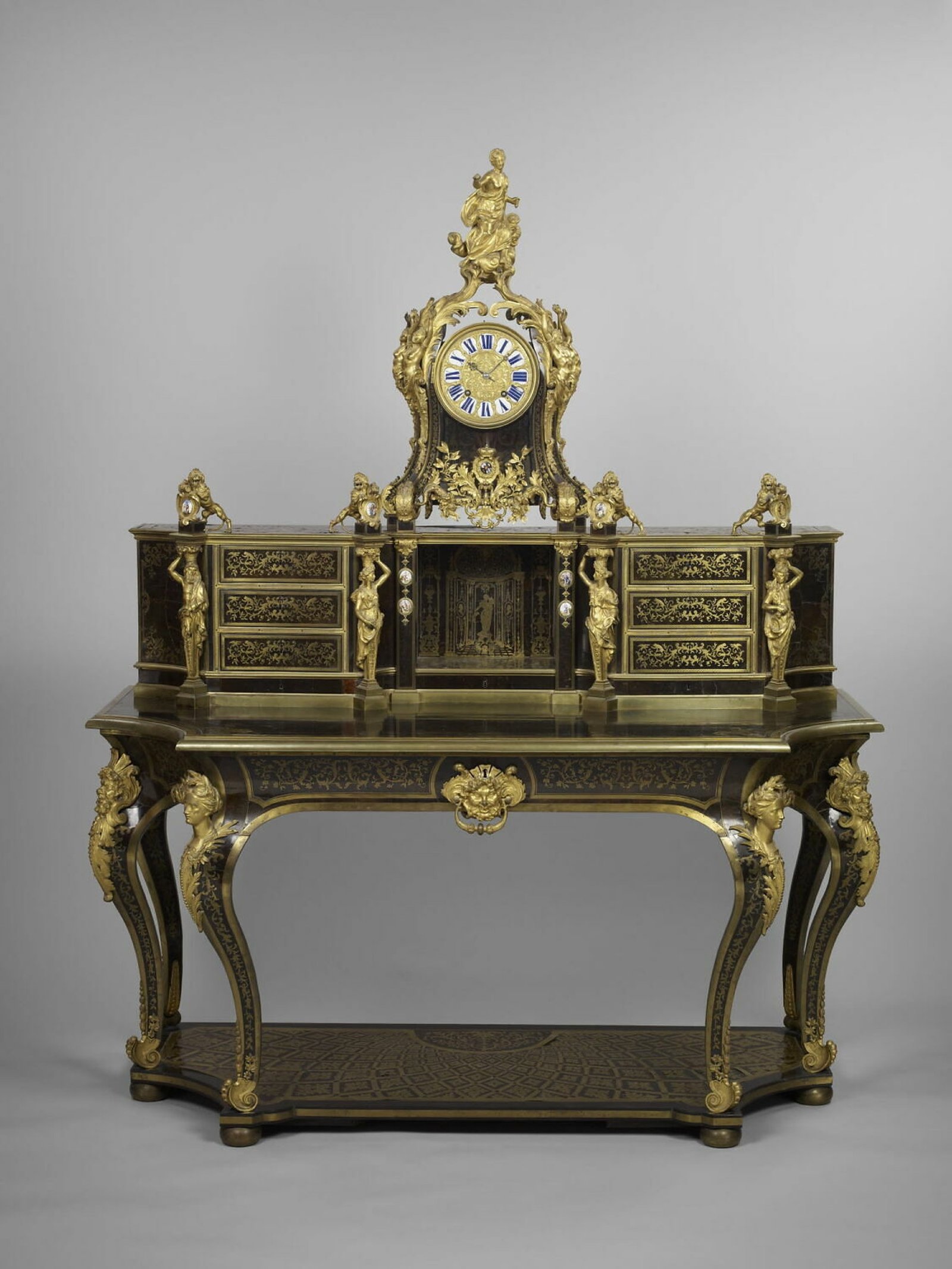
© 2012 Musée du Louvre, Dist. GrandPalaisRmn / Thierry Ollivier
The work of Bernard I Van Riesen Burgh is distinguished by rich tortoiseshell and metal marquetry, informed by a learned iconographic repertoire. He drew on prints as sources for his compositions, most notably those of the celebrated Jean Bérain (1640–1711), as well as the Emblemata Amatoria, published in Amsterdam in 1608. His marquetry panels are populated with recurring allegories and symbols. The obelisk entwined with ivy and the allegory of Abundance appear on several of his works, including the two desks made for the Elector of Bavaria mentioned above. Van Riesen Burgh also introduced a rich fantastical bestiary into his decorative schemes. On a desk from the gallery’s collection, birds, figures in exotic dress, hunters, arabesques, and imaginary architectural landscapes unfold a wondrous world against a ground of brown tortoiseshell.
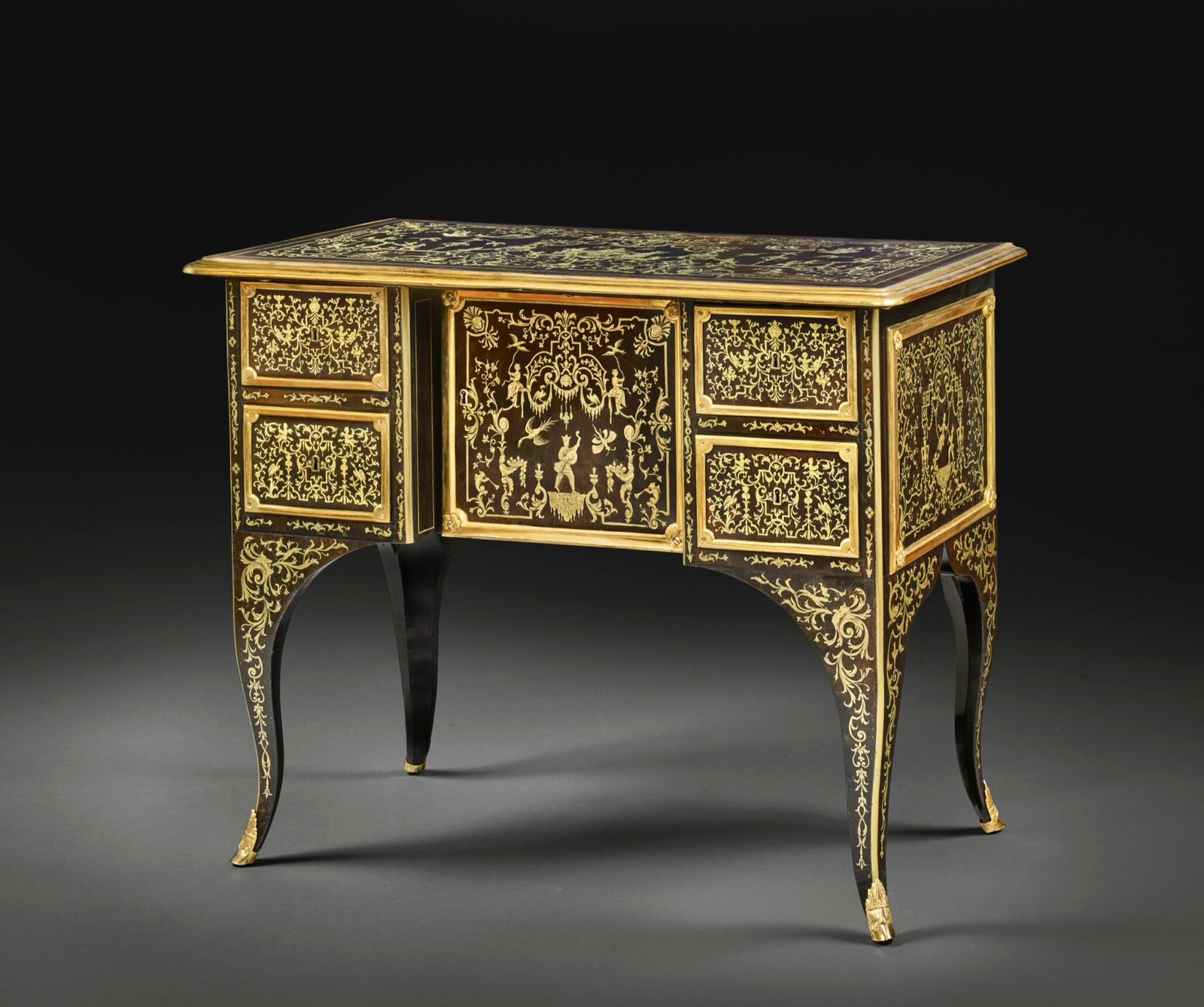
Bernard I Van Riesen Burgh remained active until his death in 1738, and ranks among the last cabinetmakers to work in metallic marquetry during the reign of Louis XV. His son, Bernard II Van Riesen Burgh, established his own cabinetmaking workshop before his father’s death. Rather than continuing his father’s work, he embraced a fully developed rocaille sensibility.
Bibliography:
Calin Demetrescu, Les ébénistes de la Couronne sous le règne de Louis XIV, La Bibliothèque des Arts, Lausanne, 2021.
Jean-Nérée Ronfort, « Bernard I Van Risamburgh (c. 1660–1738) », dans André-Charles Boulle (1642−1732). Un nouveau style pour l’Europe, cat. exp. Paris, musée des Arts Décoratifs / Somogy éditions d’art, 2009, pp. 96–100.
Jean-Nérée Ronfort et Jean-Dominique Augarde, « Le maître du bureau de l’Électeur », L’Estampille/L’Objet d’Art, n° 221, janvier 1991, pp. 42–75.

