
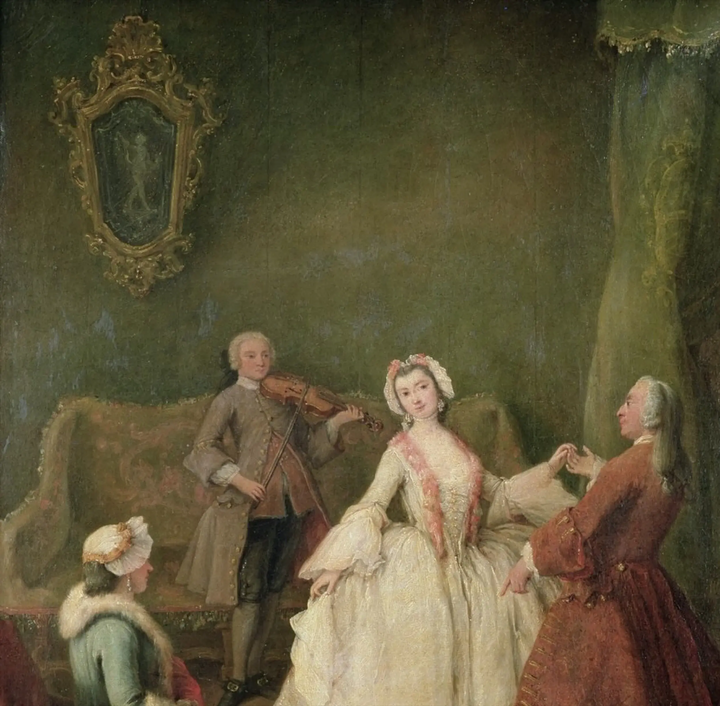
Pietro Longhi, The dancing lesson, circa 1741, Venise, Gallerie dell’Accademia (inv. 465)
Long considered the pinnacle of glassmaking in Europe, Venice is renowned for its mirrors. Jealously guarding the secret of its cristallo, Venetian artisans created precious frames to enhance this exceptional material.
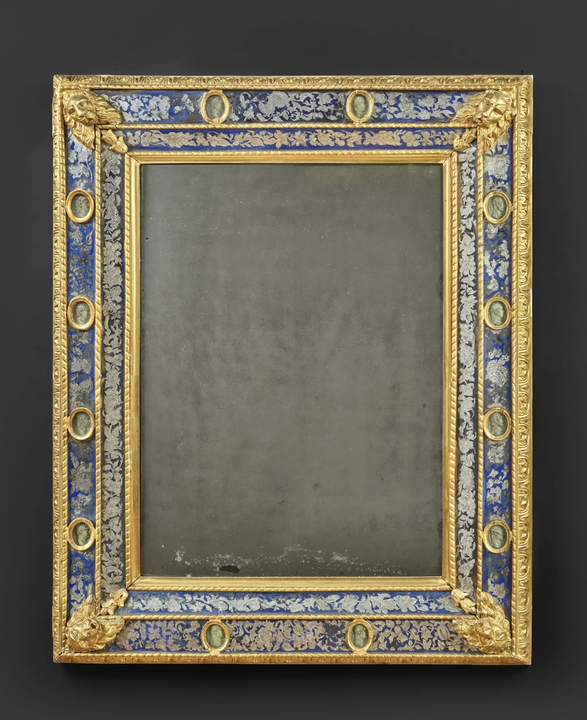
Venice, Gilded wood and verre églomisé mirror, circa 1700, Galerie Léage
In the fifteenth century, at a time when Venice was a major trading hub at the heart of Europe’s commercial and artistic exchanges, the glassmaker Angelo Barovier developed cristallo, a glass of remarkable homogeneity, transparency, and purity, entirely free of color. Immediately admired, it established the reputation of the Murano workshops. For the next two centuries, the Serenissima held a leading position in the export of glassworks throughout Europe, supplying sovereigns and their courts with objects of extreme luxury. Its manufacturing secrets were rigorously protected, and Murano artisans were forbidden to leave the island.
Among their productions, mirrors occupied a place of particular importance. From the sixteenth century onward, cabinets and galleries of mirrors appeared in aristocratic residences, and the mirror gradually detached itself from architectural decoration to become an autonomous work of art: a cristallo object lavishly framed. By the late seventeenth century and throughout the following century, Venetian mirrors were especially sought after across Europe, and artisans devoted the full extent of their skill to their creation.
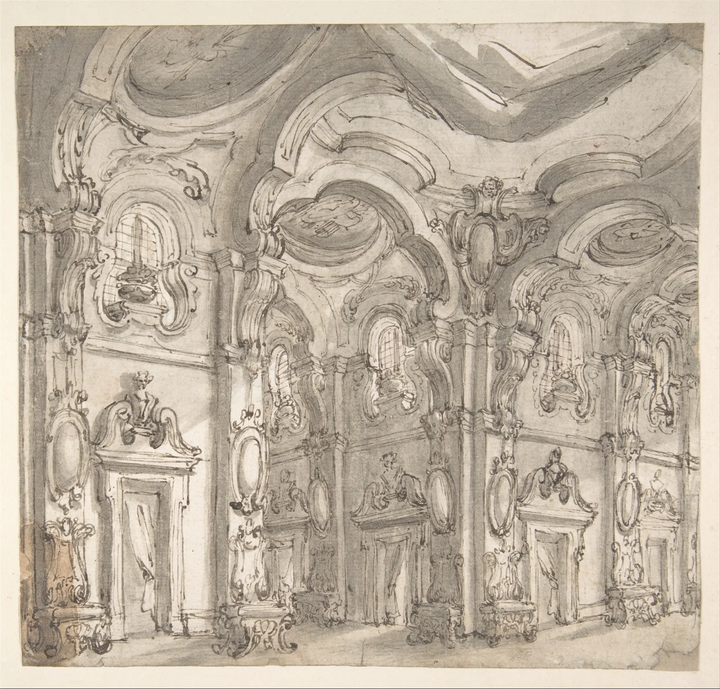
Giuseppe Galli Bibiena, Design for a Stage Set: The Gallery of a Magnificent Palace Decorated with Mirrors, 18th century, before 1756, New York, Metropolitan Museum of Art (inv. 1971.513.59)
In Venice, the manufacture of mirrors required the collaboration of numerous specialized crafts. The glass itself was first produced from precious cristallo on the island of Murano. The fonditori prepared the glass paste, which they entrusted to the soffiatori. To create a flat glass plate, the latter blew the molten glass into a regular cylinder, which was then cut lengthwise and flattened on a table. The cristallo plate was subsequently polished with great care to achieve maximum brilliance and transparency. The mirror makers, or specchieri, then took charge of the glass plates to transform them into mirrors. Based both in Murano and on the main island of Venice, they silvered the glass using a mixture of tin and mercury, producing mirrors of limited height but incomparable luminosity.
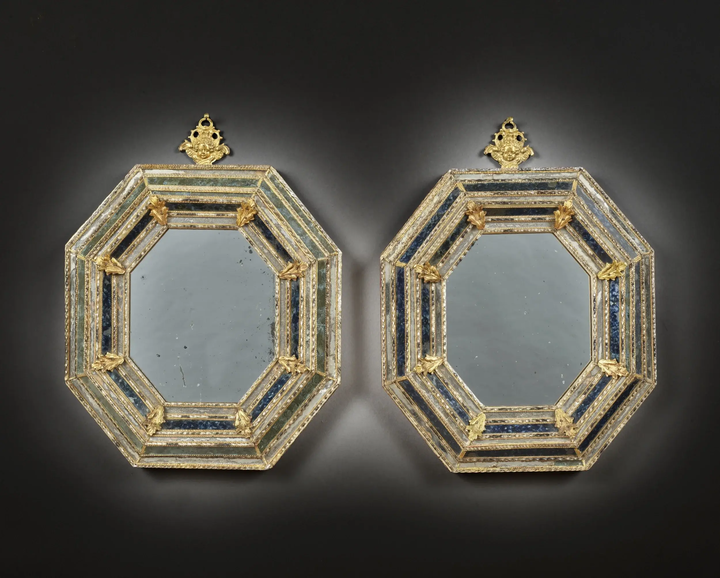
Venice, Pair of mirrors with blue and silvered glass, circa 1700, Galerie Léage
To enhance this precious material—one of Venice’s greatest sources of pride—artisans adorned it with sumptuous frames. Glass itself was often used in the framing. Colored, cut into fine plaquettes, or molded into complex shapes, it further increased the richness of the ensemble and distinguished Venetian production. Some craftsmen engraved mythological, allegorical, or pastoral scenes with a diamond point on the frame or directly onto the mirror surface, while others painted the glass or applied gold or silver leaf decoration using the technique known as verre églomisé.
Wooden frames were also highly prized, allowing sculptors to display magnificent Baroque curves. During the eighteenth century, European lacquer experienced significant development, and Venice showed particular appreciation for this material and its chinoiserie motifs. Many mirrors were thus set within lacquered frames.
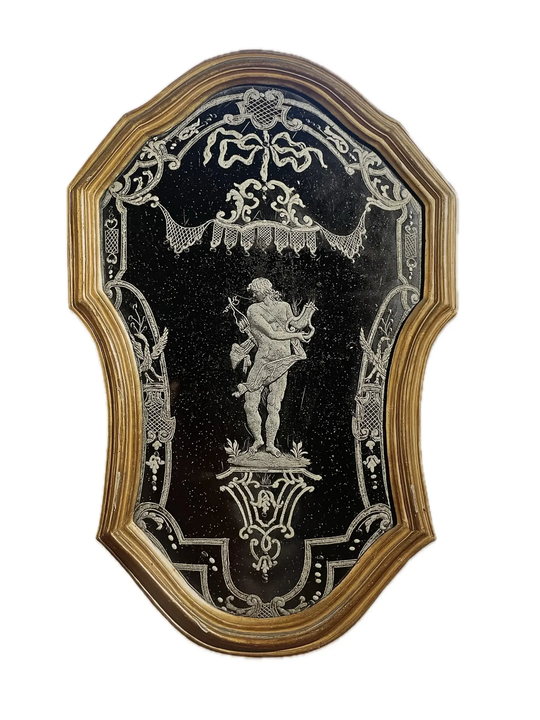
Venice, Mirror engraved with Apollo, 18th century, Murano, Museum of glass
Several workshops distinguished themselves in the art of mirror making in Venice, among which that of Ettore Bigaglia was the most important in Murano at the end of the eighteenth century. He worked cristallo to produce glass plates as well as small molded ornaments. The inventory of his workshop, drawn up in 1714, records small vegetal ornaments in glass paste. His manufactory produced the most luxurious mirrors and was capable of supplying richly ornamented and complex works, comparable to this mirror from our collection. Combining a mirror plate with molded and colored glass vegetal ornaments, cut rock crystal drops, jasper cabochons, and a gilt and embossed copper frame, it exemplifies the most sumptuous creations of the period. The exceptional quality of its materials, together with the collaboration of multiple crafts—glassmakers, lapidaries, and goldsmiths—makes it a richly complex work, intended for the European elite.
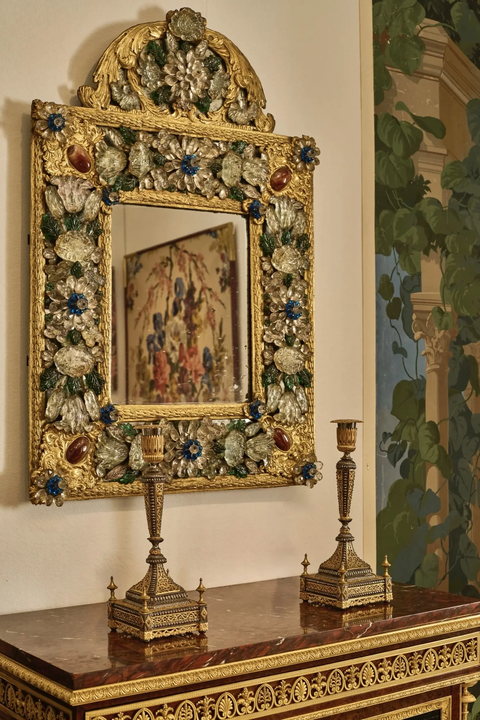
Venice, Molded glass and rock crystal mirror, late 17th century-early 18th century, Galerie Léage
From the late seventeenth century onward, Venice began to suffer from competition with French mirror makers, who succeeded in uncovering its manufacturing secrets and improving glassmaking techniques. The Galerie des Glaces at the Château de Versailles stands as the first sign of France’s growing influence in this field, an influence that would assert itself decisively throughout the eighteenth century.
Bibliography:
Attilia Dorigato, Le Verre de Murano, Citadelles et Mazenod, 2003
Graham Child, Les Miroirs. 1650–1900, Flammarion, 1990
Serge Roche, Germain Courage, Pierre Devinoy, Miroirs, Office du Livre, 1986

