
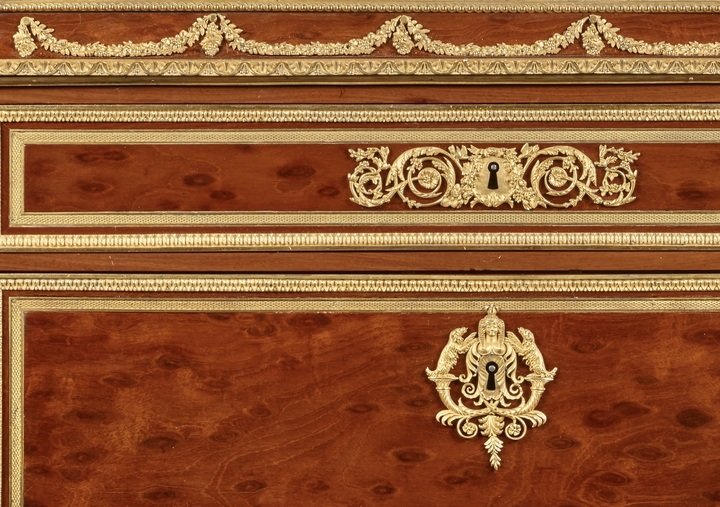
Bernard Molitor, Drop-front secretary in bird’s eye mahogany, circa 1790–1795, Galerie Léage
Formerly in the collection of Baron Alphonse (1827−1905), then Edouard (1868−1949), then Bethsabée (1914−1999) de Rothschild.
On the occasion of TEFAF Maastricht 2026, Galerie Léage has assembled a remarkable group of furniture and works of art originating from the collections of various members of the Rothschild family. Taken together, they testify to a learned, refined and colourful taste that finds a particularly striking expression in the French decorative arts of the eighteenth century.
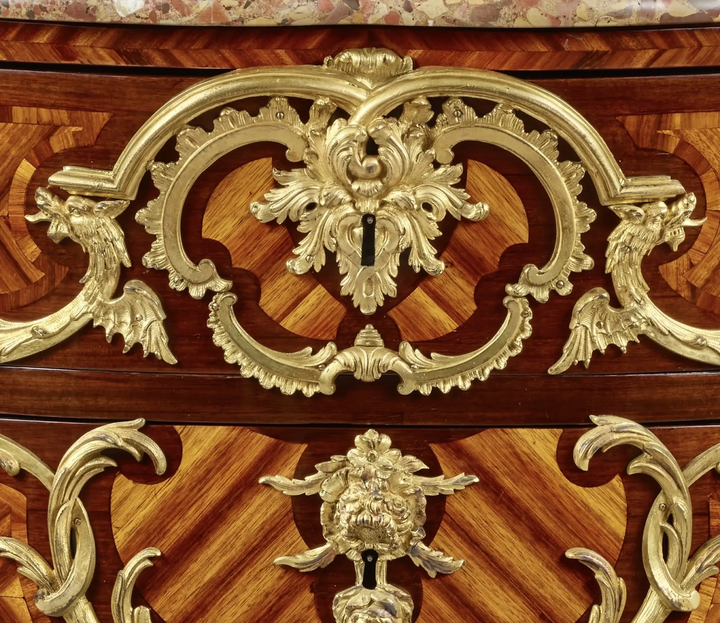
Charles Cressent, Chest of drawers with dragons and crossed palms, circa 1745–1750, Galerie Léage
Formerly in the collection of Baron Gustave (1829−1911), then Robert (1880−1946) and Alain (1910−1982) de Rothschild.
A famous banking dynasty initially active in Frankfurt, the Rothschilds established themselves in France, England, Austria and Italy during the nineteenth century. Highly accomplished financiers, they placed their expertise at the service of these various states and rapidly acquired international influence. Alongside their professional activities, members of the family cultivated a pronounced interest in the arts. Their culture and their immense fortune enabled them to assemble remarkable collections in their many residences. Ambitious collectors, they were also generous philanthropists. Since the nineteenth century, they have donated some of the finest pieces from their collections to public museums, or founded their own institutions, such as Waddesdon Manor in England or the Villa Ephrussi de Rothschild at Saint-Jean-Cap-Ferrat.
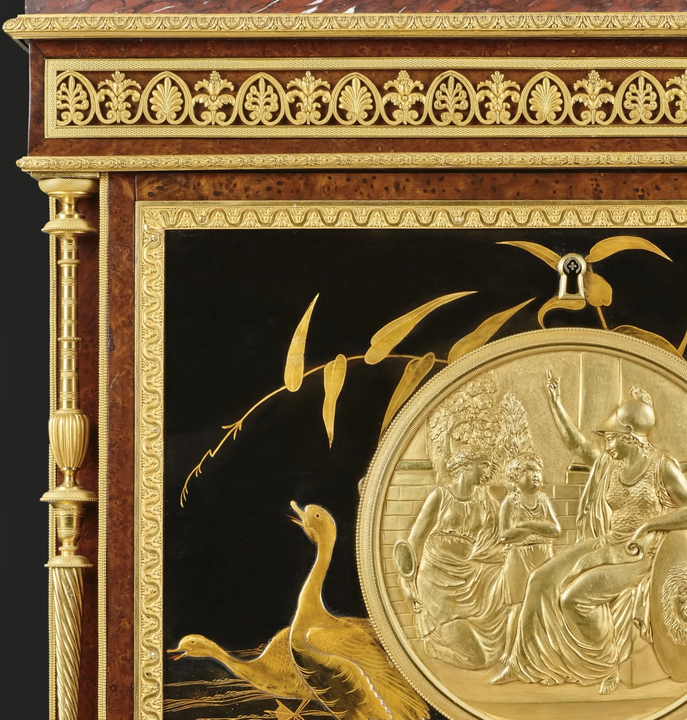
Adam Weisweiler (cabinetmaking), François Rémond (bronzes attributed to), Louis-Simon Boizot and Claude Ramey (after), Dominique Daguerre (certainly supplied by), Japanese lacquer secretary desk, with the effigy of Minerva, circa 1790–1795, Galerie Léage
Former collection of Baron Alphonse (1827−1905) then Édouard (1868−1949) de Rothschild.
Many members of the Rothschild family developed a genuine passion for collecting works of art. They formed remarkable collections characterized by a pronounced eclecticism. Antiquity, the Renaissance, as well as the modern and contemporary periods all attracted their interest. Among the French and English branches of the family were collectors of considerable stature: Baron Alphonse (1827–1905), his son Édouard (1868–1949), and his brother Gustave (1829–1911) in Paris. Mayer Amschel (1818–1874), his daughter Hannah (1851–1890) at Mentmore, and Ferdinand (1839–1898) at Waddesdon in England, to name but a few. All sought out the finest works of art throughout Europe, sometimes not without a certain rivalry. Their collections are distinguished by refined craftsmanship, vibrant colours and exceptional provenances – all hallmarks of the celebrated “Rothschild taste”.
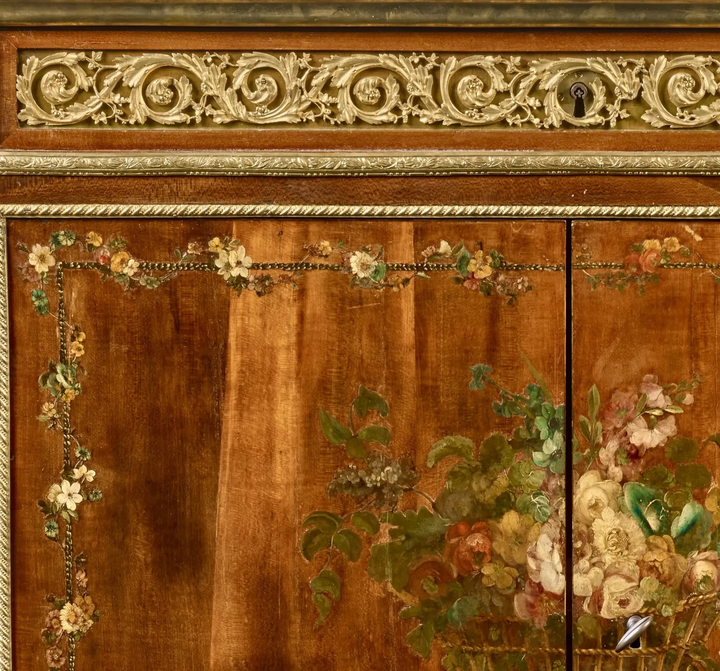
Ferdinand Bury (cabinetmaking attributed to), Jean-Louis Prévost (painted decoration attributed to), Jean-Baptiste II Tuart (probably delivered by), Pair of painted low cabinets, circa 1770–1775, galerie Léage
Former collection of Hannah Primerose née Rothschild (1851−1890).
Great builders as well as collectors, the Rothschilds constructed ambitious residences across Europe. Within them they arranged their collections in a carefully conceived yet comfortable display that truly embodied the famous “Rothschild taste”. The Château de Ferrières, built by Baron James de Rothschild (1829–1911) between 1855 and 1859, is one of the foremost expressions of this much-admired taste. Its interiors were conceived by the painter Eugène Lami (1800–1890), who drew inspiration from Italian architecture and above all from Versailles to create sumptuous rooms where precious furniture, Old Master paintings and works of art were artfully assembled. On behalf of the Baron, Lami travelled throughout Europe in search of works that would complete these interiors, thus combining collecting and decoration. The theatricality and opulence of these interiors left a lasting impression on contemporaries. The historian Henry Havard even defined a “Rothschild” in his Dictionnaire de l’ameublement as a broad and generously proportioned armchair.
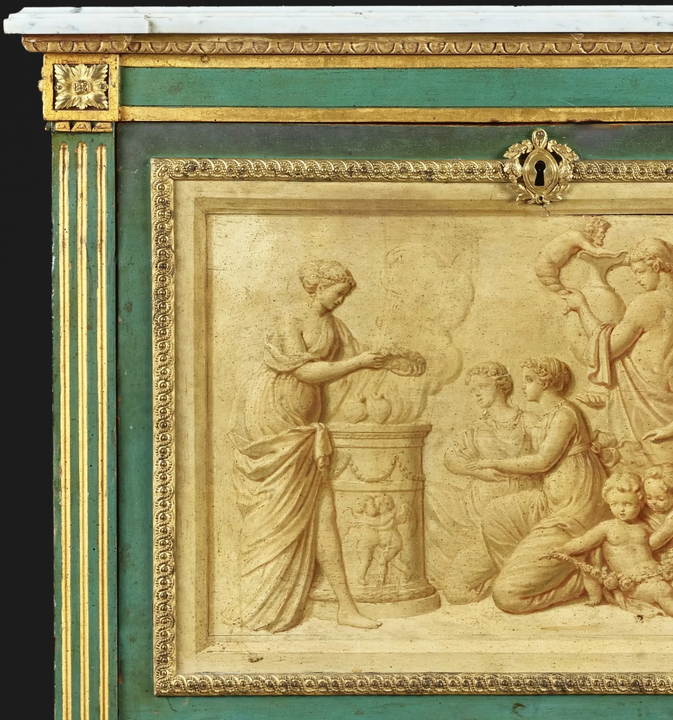
René Dubois (attributed to), Secretary painted in monochrome, circa 1770, galerie Léage
Former collection of Baroness Hélène Betty Louise Caroline van Zuylen van Nyevelt de Haar, née de Rothschild (1863−1947), then Marie-Hélène de Rothschild (1927−1996).
French eighteenth-century decorative arts hold a special place in Rothschild collections. Several masterpieces of the period once featured in their residences, such as the chest of drawers in European lacquer made by Mathieu Criaerd (c.1689–1776) for Madame de Mailly at the Château de Choisy, now in the Musée du Louvre (inv. OA 11292), or the camaïeu table by René Dubois (1737–1799) preserved at the Villa Ephrussi.
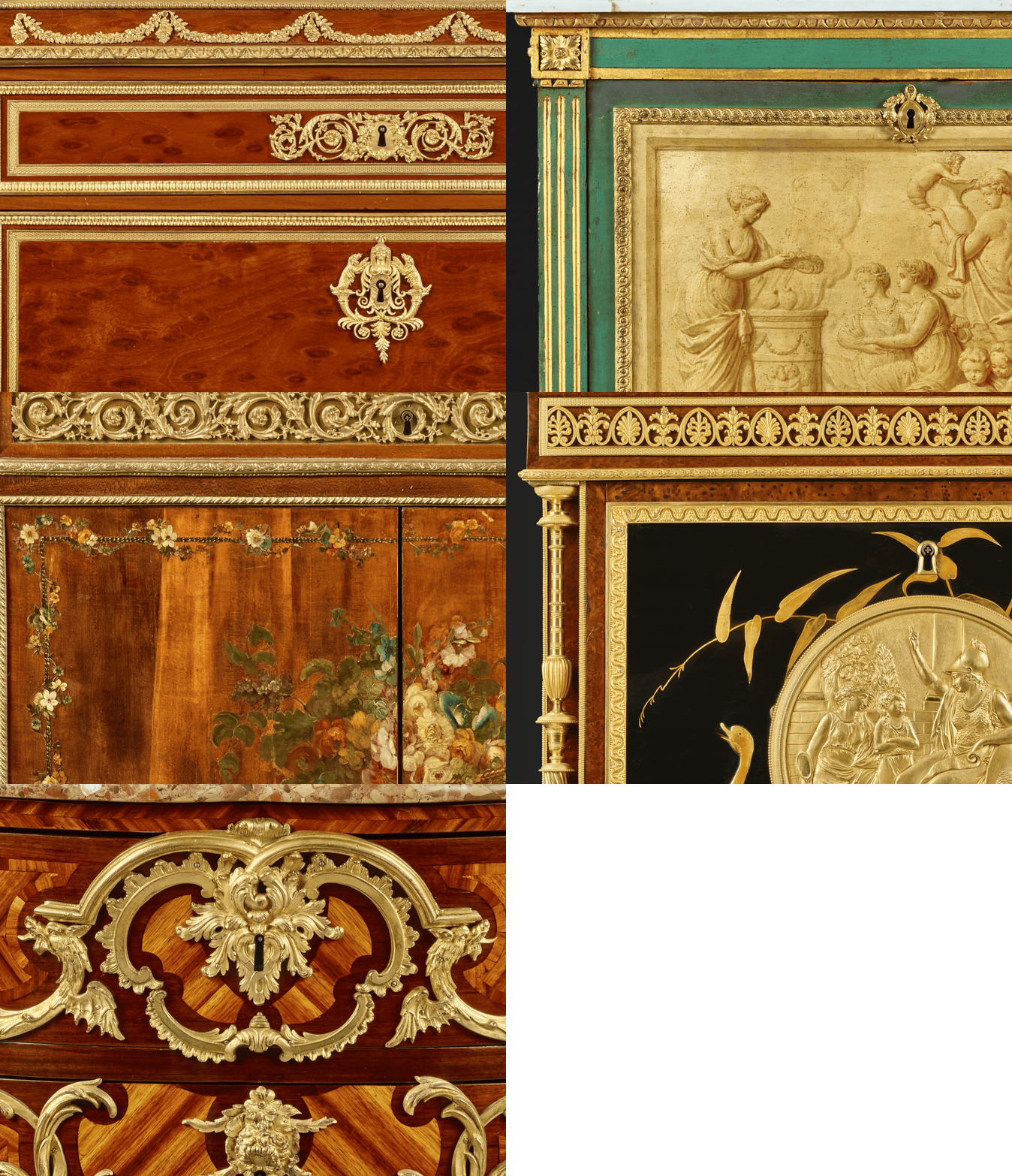
Other remarkable works from Rothschild collections will be presented on our stand at TEFAF Maastricht 2026. A pair of cabinets veneered in sycamore maple, formerly at Mentmore in the collection of Hannah Primrose Hill, née Rothschild, bears witness to a particularly rare and luxurious group of oil-painted furniture. Also on display will be a richly veneered chest of drawers adorned with gilt-bronze mounts in the form of dragons and crossed palm fronds, among the emblematic pieces created by the cabinetmaker and bronzier Charles Cressent (1685–1768). A delicate secretary veneered in bird’s eye mahogany by Bernard Molitor (1755–1833), a rare painted secretary by René Dubois, and another veneered with superb Japanese lacquer panels will also be presented.
Bibliography:
Pauline Prévost-Marcilhacy (dir.), Les Rothschild. Une dynastie de mécènes en France, Somogy Éditions d’art, 2016
Pauline Prévost-Marcilhacy, Les Rothschild, bâtisseurs et mécènes, Flammarion, 1995

