
Decorator and draftsman
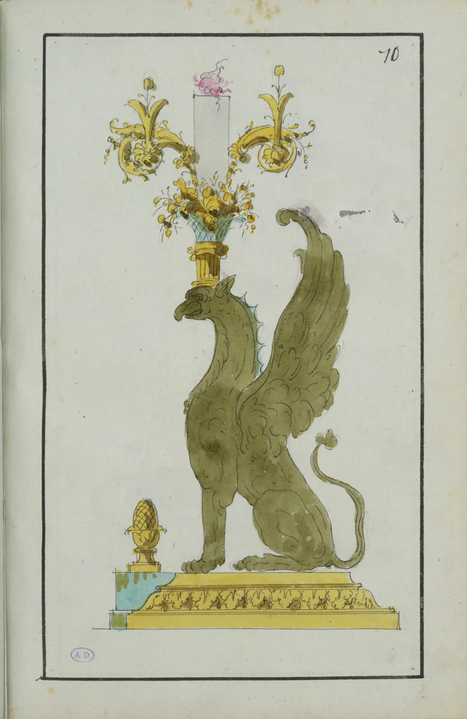
Richard de Lalonde, [Design of girandoles], from the album of drawings for a marchand mercier, circa 1780–1790, Paris, Musée des arts décoratifs (inv. CD 189.70)
© Les Arts Décoratifs
Designer, model-maker, and ornamentalist, Richard de Lalonde (1735–1808) was one of the leading figures of French Neoclassicism. Still little studied today, he produced a rich and original body of work.
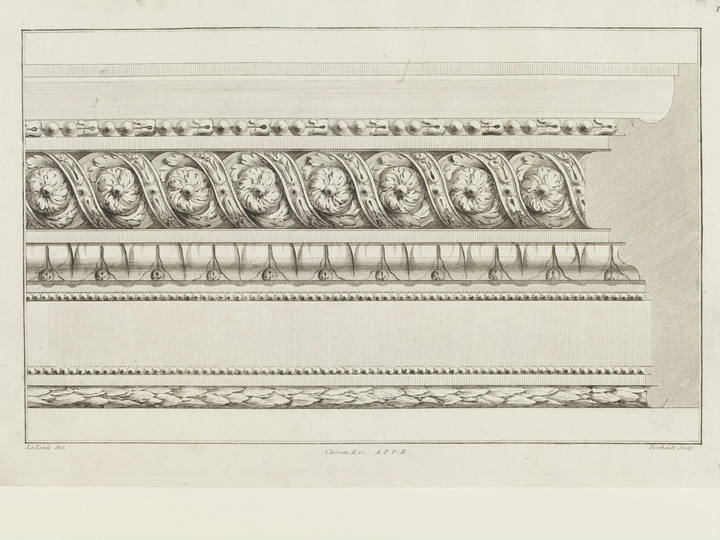
Richard de Lalonde (designer), Berthault (engraver), Chéreau (publisher), [Friezes], in Oeuvres diverses de Lalonde décorateur et dessinateur, circa 1775–1789, London, Victoria & Albert Museum (inv. E.5175–1910)
© Victoria and Albert Museum, London
Little is known about the early years of Richard de Lalonde’s career, but his name appears as early as 1760 in the accounts of the Menus-Plaisirs du Roi. Responsible for producing all the elements required for the splendor of the court, this royal administration employed numerous draftsmen to create stage sets and costumes. Lalonde’s reputation was firmly established from the 1780s onward, when many engravings of his designs for furniture and decorative objects were published in Paris. He worked for a distinguished clientele, including the Comte de Provence, the king’s brother, for whom he designed a chest of drawers executed by Joseph Stöckel (1743–1802) in 1786. Two years later, he provided designs for two mahogany console tables intended for the Salon des Jeux du roi at the Château de Saint-Cloud. Lalonde thus stood at the very heart of the creative process behind royal furniture.
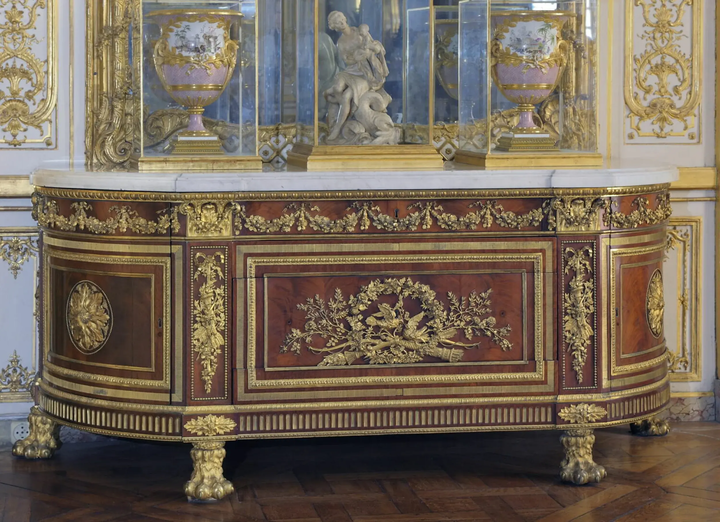
Richard de Lalonde (after), Joseph Stockel (ébénisterie), Guillaume Benneman (then reworked by), Chest of drawers, first delivered for the Comte de Provence then bought by Louis XVI, 1786, Paris, Musée du Louvre (inv. OA 5507)
© 2011 GrandPalaisRmn (musée du Louvre) / RMN Agence photo
Richard de Lalonde’s work is known primarily through engraving. Beginning in 1783–1784, his designs were assembled into pattern books published by Jacques-François Chéreau and engraved by J. B. Fay and Berthault. Their precise draftsmanship and refined, delicate ornament ensured their success with a wide audience. As early as 1781, Jean-Félix Watin praised Lalonde’s “perfect and modern taste” in his celebrated L’Art du peintre, doreur, vernisseur, describing it as both simple and elegant. His work reflects a mature Neoclassicism, combining forms, materials, and ornament with balance and harmony, in a richly articulated Louis XVI style infused with arabesques and Etruscan-inspired motifs. His engraved designs circulated widely throughout France as well as in Flanders, the Netherlands, Germany, and England, contributing to the dissemination of French taste across Europe. Several collections were published between 1783 and the very end of the eighteenth century.
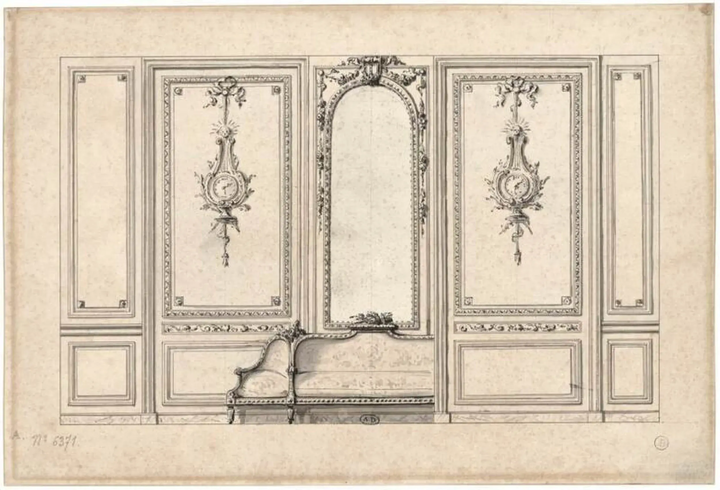
Richard de Lalonde, [Project for the décor of a salon], circa 1780–1785, Paris, Musée des arts décoratifs (inv. 6371)
© Les Arts Décoratifs
In the title of his first collection, published in 1783–1784, Richard de Lalonde describes himself as a “decorator and draftsman.” The term “decorator,” as understood today—a specialist in interior design selecting and arranging decorative elements—did not exist in the eighteenth century. At the time, it referred more specifically to designers of ephemeral settings for theatrical productions or festivities. Yet Lalonde approaches this modern role in several respects. Certain creators of the period—architects, draftsmen, or cabinetmakers—practiced in ways comparable to that of the modern interior decorator. They conceived models and oversaw the creation of complete interiors, in which every piece of furniture and object occupied a defined place. Lalonde likewise produced designs for entire interiors, where paneling, mirrors, furniture, and objects formed a coherent whole. Although no interiors can currently be definitively linked to his designs, several pieces of furniture are directly inspired by his projects.
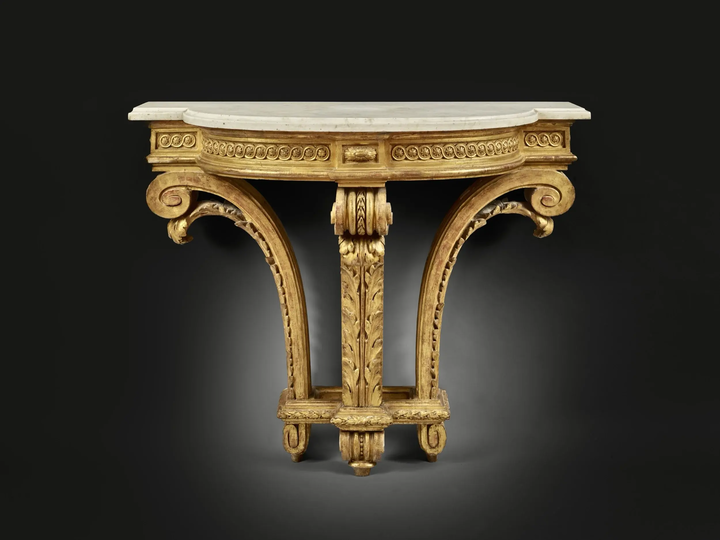
Richard de Lalonde (after), Pair of consoles with scrolls, circa 1775–1780, Galerie Léage
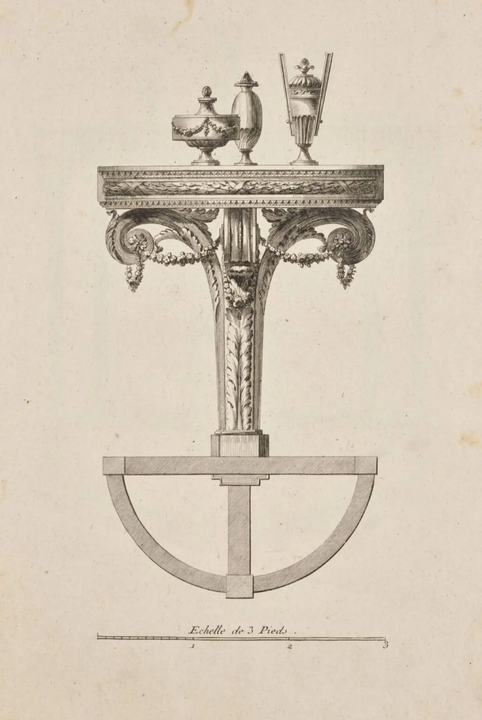
Richard de Lalonde (designer), Fouin (engraver), Chéreau (publisher), [Console], 1776–1788, Versailles, Châteaux de Versailles et de Trianon (inv. V.2024.51.26)
© Château de Versailles, Dist. RMN / © Christophe Fouin
Lalonde also collaborated with marchands-merciers, providing them with detailed designs for furniture and decorative objects. The Musée des Arts Décoratifs in Paris preserves a rare album of his drawings, comprising 94 designs for parquet floors, firedogs, lanterns, chests of drawers, and various types of desks. It was likely intended for a marchand-mercier—possibly Simon-Philippe Poirier (c. 1720–1785) or Dominique Daguerre (1740–1796)—who would have presented these works to his clientele. Whether based on existing pieces from the merchant’s stock or conceived as variations prior to execution, these drawings offer a valuable insight into the commissioning process in the eighteenth century. Detailing carved and gilt elements, they also provide practical technical information for the craftsmen responsible for their execution.
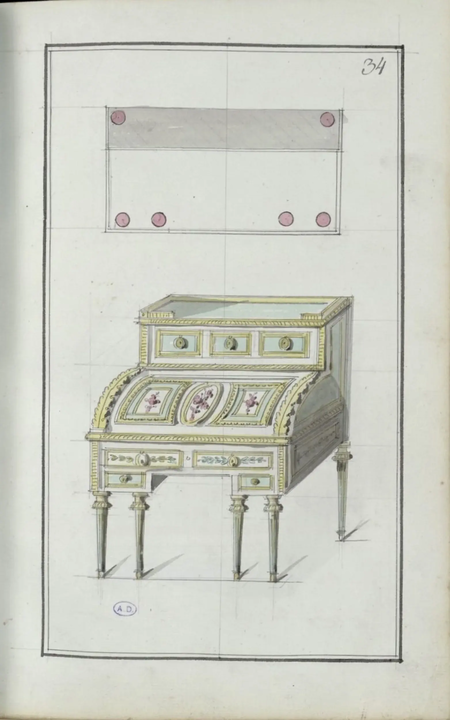
Richard de Lalonde, [Small rolltop desk], from the album for a marchand mercier, circa 1785–1790, Paris, Musée des Arts décoratifs (inv. CD 189.34)
© Les Arts Décoratifs
One of the great interpreters of the Louis XVI style, Richard de Lalonde produced designs of remarkable refinement and elegance, widely disseminated through engraving. Working with both the royal administration and the leading marchands-merciers, he played a central role in shaping the decorative arts of his time.
Bibliography:
Ouvrage collectif, 18e aux sources du design, Éditions Faton, 2014
Rainier Baarsen, Process. Design Drawings from the Rijksmuseum 1500–1900, nai010, 2022
Peter Fuhring, Designing the décor. French drawings from the eighteenth century, Calouste Gulbenkian Foundation, 2005

