
Saxony’s white gold
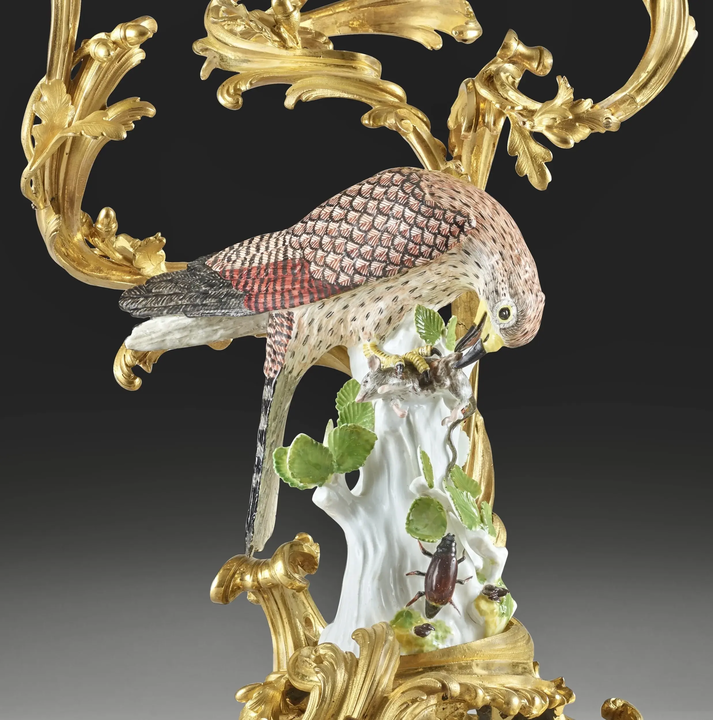
Johann Joachim Kändler (after), Jacques or Philippe Caffieri (bronzes attributed to), Lazare Duvaux (probably delivered by), Pair of candelabra with birds of prey, detail, circa 1745, Galerie Léage
H: 75 cm — 29 1⁄2 inches — W: 42 cm — 16 1⁄2 inches — D: 36 cm — 14 1⁄4 inches
Come and see them at our stand 122 at TEFAF Maastricht from March 14 to 19.
Hard-paste porcelain, the much-coveted “white gold” of the eighteenth century, was initially the exclusive preserve of the Meissen manufactory. Its artisans and chemists developed a paste, colors, forms, and decorative motifs that revolutionized the art of European ceramics.
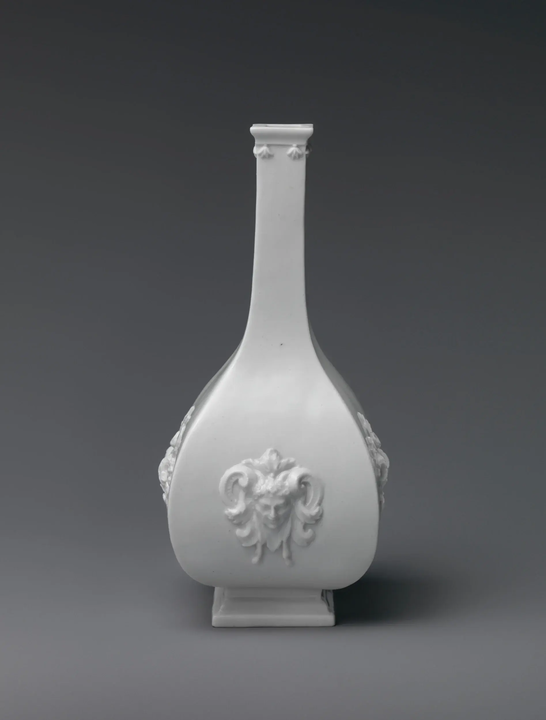
Meissen Manufactory, Johann Friedrich Böttger (under the direction of), Johan Jakob Irminger (modeler), Bottle, circa 1713–1720, New York, Metropolitan Museum of Arts (inv. 1974.356.499)
In 1701, the Prussian Johann Friedrich Böttger (1682–1719) fled to Saxony to escape the King of Prussia, who sought to seize his valuable alchemical knowledge. It was ultimately the Duke of Saxony, Augustus II the Strong, who had him imprisoned and required him to continue his research. Passionate about Asian porcelain, the Duke took a particular interest in the manufacturing techniques of this precious material, until then unknown in Europe. In 1709, the alchemist announced that he had discovered the secret of hard-paste porcelain. The following year, Augustus II founded the Meissen manufactory and tasked Böttger with refining his discovery. Saxony thus became the first European region to produce porcelain with the same qualities of whiteness, translucency, and strength as Chinese and Japanese porcelain.
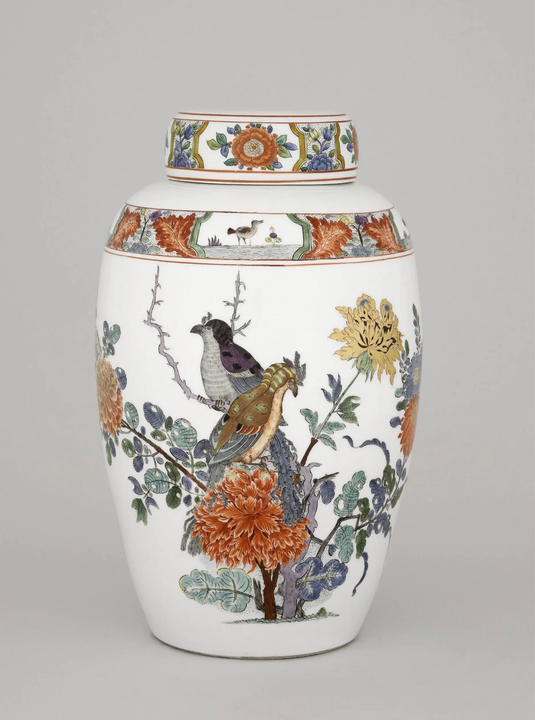
Meissen Manufactory, Vase, circa 1734, Versailles, Palace of Versailles and Trianon (inv. VMB 14405)
© RMN-GP (Palace of Versailles) / © Franck Raux
The first porcelain pieces were produced in imitation of Asian wares. Augustus II the Strong made his vast collection available to the artisans—by the late 1720s he owned nearly 25,000 pieces—to serve as models. In 1720, the painter Johann Gregorius Höroldt (1696–1775) joined the manufactory and introduced a crucial technique, overglaze enamel painting (“petit feu”). This process made it possible to apply a wide range of vibrant colors to porcelain, more faithfully reproduce imported models, and invent new decorative schemes. Endowed with a fertile imagination, Höroldt fostered a taste for chinoiserie and designed numerous scenes compiled in an album known as the Schulz-Codex, which workshop painters subsequently drew upon.
In 1727, the Duke undertook major renovations to transform his Dutch Palace, which housed his collections of Asian and Saxon porcelains, into an immense Japanese Palace with an ambitious decorative program. Beginning in 1730, he reorganized the display of the works: Asian porcelains would be exhibited on the ground floor, while the manufactory’s productions would be displayed on the upper level. This arrangement was symbolic: Saxon porcelain was now considered superior to its Eastern counterpart.
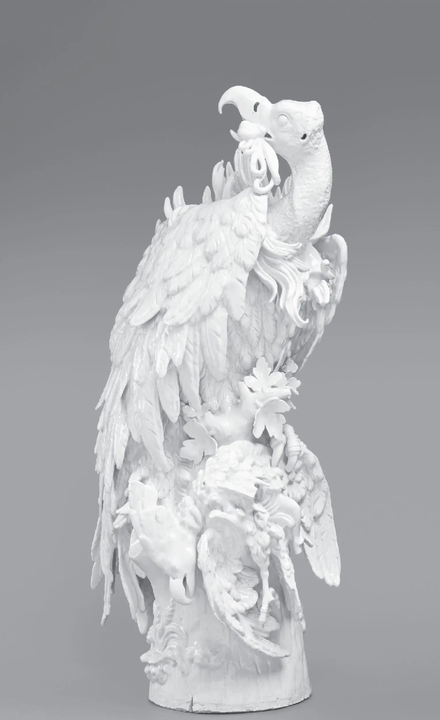
Meissen Manufactory, Johann Joachim Kändler (after), Vulture devouring a cockatoo, 1734, Sèvres, National Ceramics Museum (inv. MNC 2275.5)
©RMN-Grand Palais Sèvres Cité de la céramique-Adrien Didierjean
To decorate his Japanese Palace, the Duke of Saxony called upon Johann Joachim Kändler (1706–1775), who joined the manufactory in 1731. He commissioned ambitious naturalistic sculptures, including life-size birds. Kändler conceived compositions of unprecedented scale, demonstrating remarkable sensitivity, attention to detail, and technical mastery. He also produced smaller sculptural groups—genre scenes and a variety of animals—that were highly prized by European collectors. The precision of their modeling and their lively poses reveal a light and playful taste. The porcelain master also designed table services, including the magnificent Swan Service for Count von Brühl, as well as tureens and candelabra. By this time, the “white gold” had been fully mastered by the artisans of Meissen and adapted to European taste and customs.
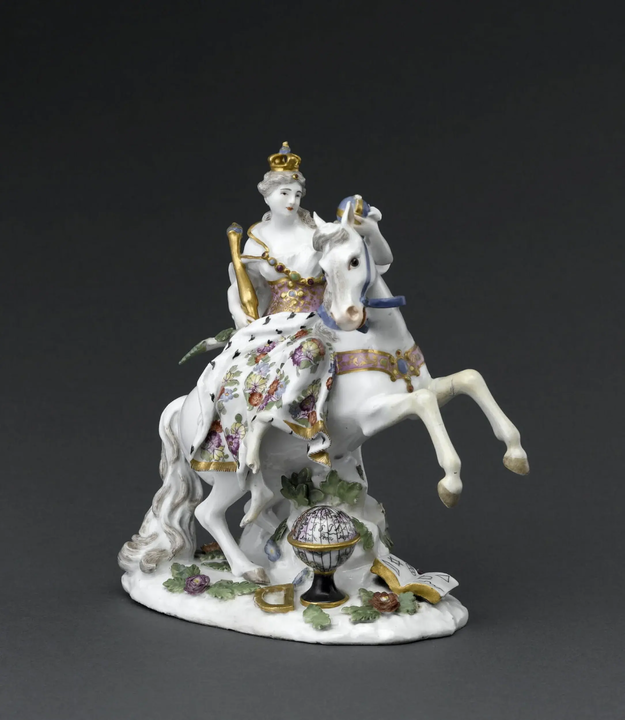
Meissen Manufactory, Johann Joachim Kändler (after), The Four Parts of the World: Europe, 1745, Paris, Louvre Museum (inv. OA 8052)
© 2007 GrandPalaisRmn (Louvre Museum) / Jean-Gilles Berizzi
Saxon porcelain was highly sought after throughout Europe, particularly in Paris, where marchand merciers and faïenciers (ceramic dealers) sold and transformed it. The faïenciers Jean-Charles Huet and Henri Le Brun appear to have held a near-monopoly on Meissen porcelain in Paris until the late 1730s. It was subsequently found in the shops of renowned merchants such as Lazare Duvaux (1703–1758) and Thomas-Joachim Hébert (1687–1773). They mounted Meissen sculptural groups in superb gilt-bronze settings, transforming them into candelabra, clocks, or inkwells. They sometimes combined them with pieces from Vincennes-Sèvres or Chantilly in complex compositions.
A pair of candelabra with birds of prey, probably delivered by Lazare Duvaux around 1745, will be exhibited at our booth at TEFAF Maastricht. The two porcelain groups, based on Kändler’s models of 1734 and 1739, are framed by sweeping rocaille gilt-bronze arms attributed to Jacques (1678–1755) or Philippe Caffieri (1714–1774). Brilliantly conceived, they reveal a subtle balance in which the bronze extends the porcelain compositions in a single, fluid movement.
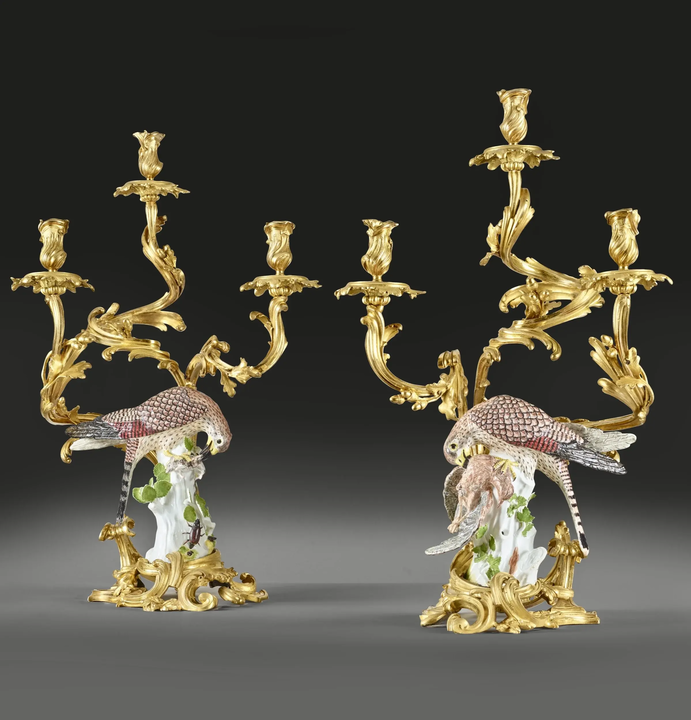
Johann Joachim Kändler (after), Jacques or Philippe Caffieri (bronzes attributed to), Lazare Duvaux (probably delivered by), Pair of candelabra with birds of prey, circa 1745, Galerie Léage
H: 75 cm — 29 1⁄2 inches — W: 42 cm — 16 1⁄2 inches — D: 36 cm — 14 1⁄4 inches
Come and see them at our stand 122 at TEFAF Maastricht from March 14 to 19.
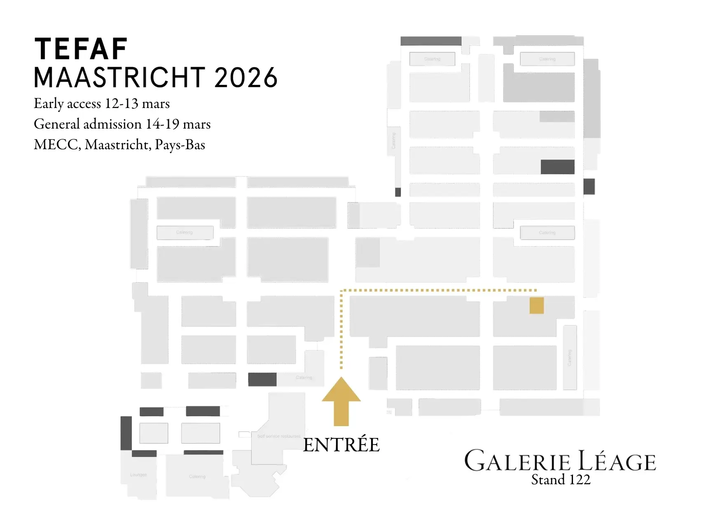
We invite you to discover these masterpieces of the Meissen manufactory and admire the artistry of the Parisian marchand merciers at our booth 122 at TEFAF Maastricht, from March 14 to 19.
Bibliography:
Antoinette Faÿ-Hallé, Comment reconnaître une porcelaine de Saxe du XVIIIe siècle, Éditions de la réunion des musées nationaux, 2008
Mathieu Deldicque (dir.), Porcelaines de Meissen et de Chantilly. La fabrique de l’extravagance, Éditions Monelle Hayot, 2020

