
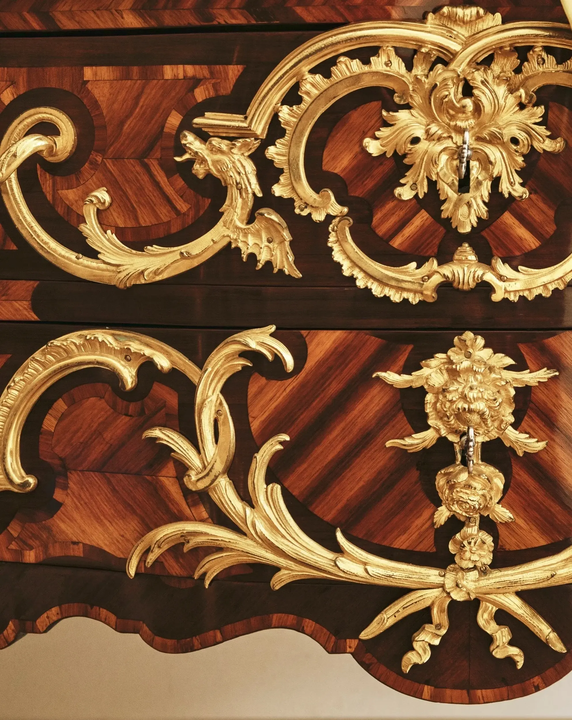
Charles Cressent, Chest of drawers with crossed palms and dragons, detail, circa 1745–1750, Galerie Léage
Exhibited on our stand 122 at TEFAF Maastricht from March 14 to 19.
A master bronzier and cabinetmaker, Charles Cressent established himself in the first half of the eighteenth century as one of the most celebrated artisans working in Paris. By uniting these two professions, he created furniture of remarkable luxury and originality.
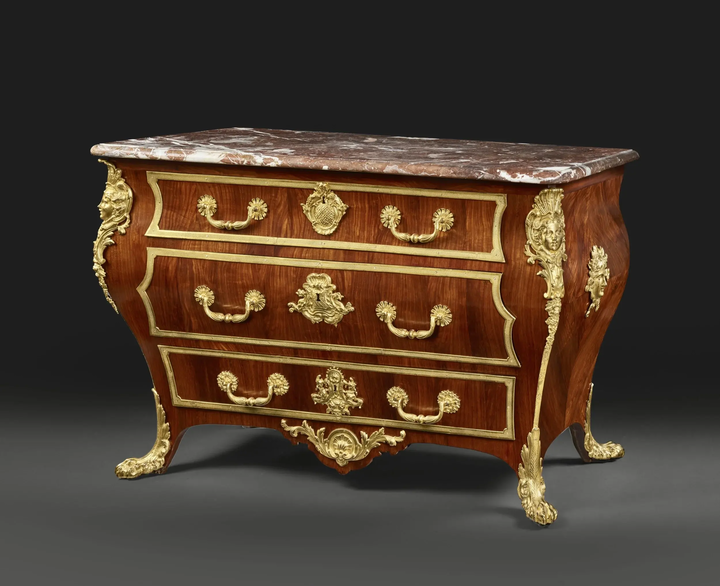
Joseph Poitou (cabinetmaking attributed to), Charles Cressent (bronzes attributed to), Chest of drawers, Louis XIV period, first quarter of the 18th century, Galerie Léage
Born in Amiens in 1685, Cressent was the grandson of a joiner and the son of a sculptor. He thus received a dual training and, in 1714, was received Master sculptor in Paris. Specializing in the chasing of fine bronzes, he first worked for the sculptor François Girardon (1628–1715). Joseph Poitou (1682–1719), rival of the great cabinetmaker and bronze maker André-Charles Boulle (1642–1732), subsequently employed him to execute the bronze mounts for his furniture. Upon Poitou’s death in 1719, Cressent married his widow and took over his workshop in the rue Jonquelet. He thereafter both designed and executed the cabinetry and the gilt-bronze mounts for his furniture — an almost unique situation in the eighteenth century.
In his shop, he displayed the luxurious pieces he produced alongside Old Master paintings, medals, ivories and other precious objects from his own private collection. A virtuoso creator, Cressent was also a cultivated man and a discerning collector. Several sales of his collections, held in 1748, 1756 and 1765, testify to their exceptional quality.
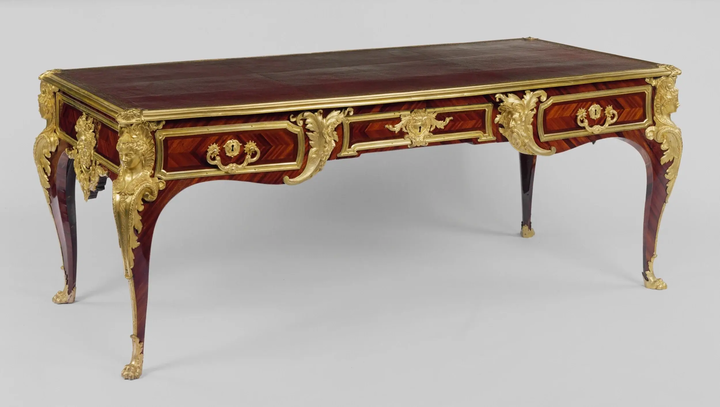
Charles Cressent (attributed to), Flat desk with “espagnolettes”, circa 1720–1725, Los Angeles, J. Paul Getty Museum (inv. 67.DA.10)
Pieces from his stock were also offered in these auctions. The sale catalogues provide detailed descriptions of his furniture and today enable scholars to attribute works to him despite the absence of a maker’s stamp. Throughout his career, Cressent devised several distinctive models — notably highly original clocks and firedogs — and produced numerous chests of drawers, cupboards and writing tables. He was particularly fond of veneer marquetry in geometric patterns or frisage. Playing with the grain of tulipwood, amaranth and satinwood, he created restrained yet elegant compositions. Arranged in diamond-point or butterfly-wing patterns, these designs enhance the gilt-bronze mounts, sometimes framed with amaranth filets. Cressent was also among the first to use satinwood veneers, notably in the two-drawer, two-door chest now preserved in the Musée du Louvre (inv. OA 10900).
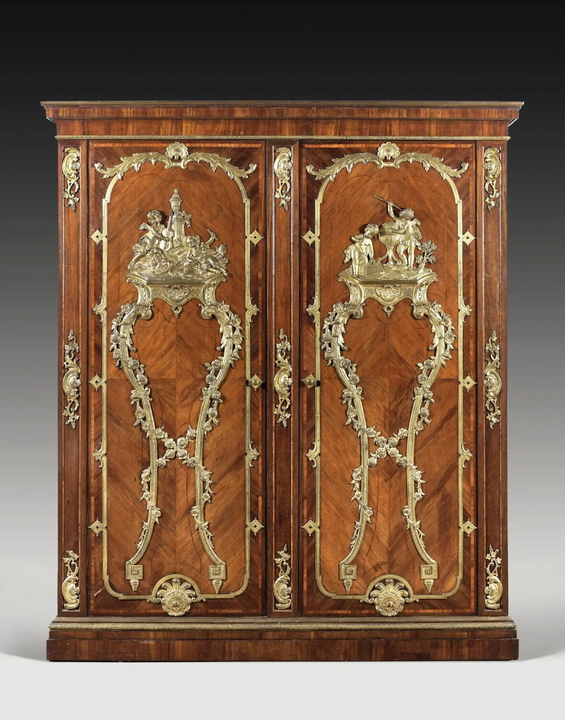
Charles Cressent, Cupboard, 1740–1760, Paris, Musée du Louvre (inv. OA 10582)
© 2010 Musée du Louvre / Département des Objets d’art du Moyen Age, de la Renaissance et des temps modernes
Despite the prohibition imposed by the guild of joiner-cabinetmakers against practicing two professions — and the disputes that followed — Cressent continued throughout his career to create the gilt-bronze mounts for his own furniture. He accorded them particular prominence, thereby distinguishing himself from his contemporaries. As a bronzier, he deployed remarkable inventiveness in the service of a powerful yet balanced rocaille taste. Floral ornaments, pierced clasps and scrolling foliage appear throughout his work. He developed several original motifs, such as the female busts known as “espagnolettes”, which adorn many of the corner mounts of his desks, as well as compositions featuring monkeys in a characteristically rocaille exoticism. Cressent also populated his mounts with fantastic creatures: between 1745 and 1750, a remarkable group of chests of drawers known as the “crossed palm and dragons” model was produced in his workshop.
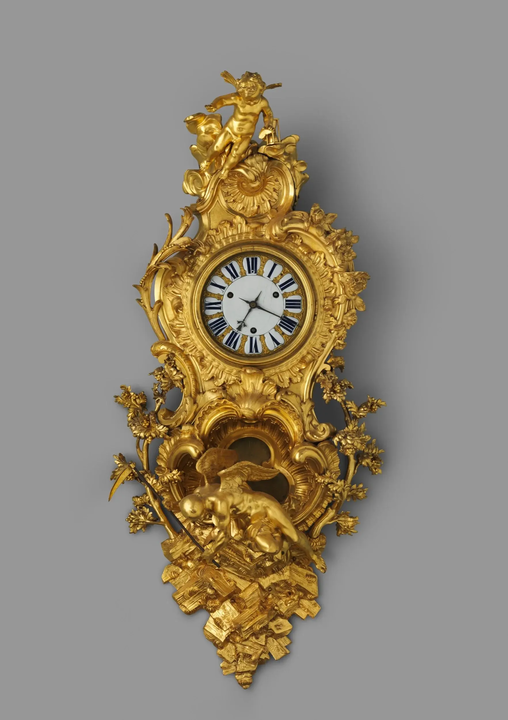
Charles Cressent, Jean Godde the Elder (clockmaker), Cartel clock, circa 1740–1745, New York, Metropolitan Museum of Arts (inv. 1971.206.27)
Cressent enjoyed an important clientele, including some of the most discerning collectors of the eighteenth century. Privileged cabinetmaker to the Regent, Philippe II, Duc d’Orléans, at the beginning of his career, he later developed a distinguished private clientele — including the Marquis de Marigny and his sister Madame de Pompadour, the Duc de Richelieu, as well as numerous members of the aristocracy and the financial elite. He also occasionally sold his works through marchands merciers or fellow cabinetmakers such as Antoine-Robert Gaudreaux (c. 1680–1746). His reputation in Paris was firmly established by the 1720s, and the resounding success of his various sales only reinforced it. His talent was repeatedly praised by Parisian men of letters; in his Nouvelles littéraires (1749), in a chapter devoted to the great sculptors of the time, the abbé Raynal wrote that Cressent “deserves a place among the great French artists” and that he “has succeeded to the reputation of the famous Boulle.” His renown even extended beyond France: King João V of Portugal, Charles-Albert, Elector of Bavaria, and Queen Charlotte of Great Britain all owned pieces from his workshop.
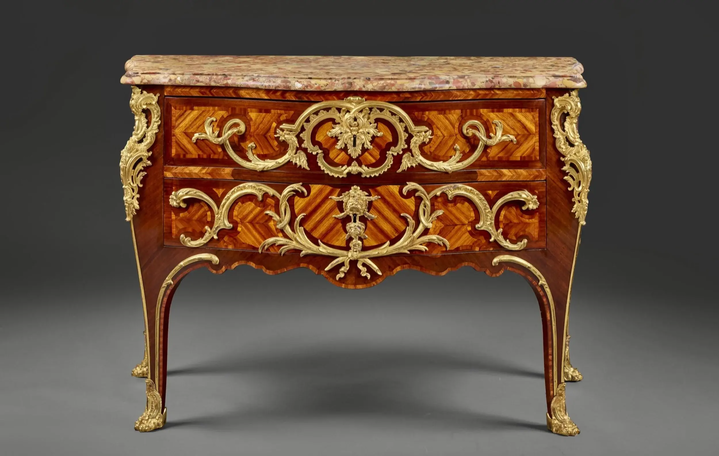
Charles Cressent, Chest of drawers with crossed palms and dragons, circa 1745–1750, Galerie Léage
Exhibited on our stand 122 at TEFAF Maastricht from March 14 to 19.
A distinguished bronzier and cabinetmaker, Charles Cressent created furniture of exceptional luxury in the eighteenth century. One of the commodes from the celebrated “crossed palm and dragons” group will be on view on our stand at TEFAF Maastricht, 14–19 March.
Bibliography:
Alexandre Pradère, Charles Cressent, Éditions Faton, 2003.
François de Salverte, Les ébénistes français du XVIIIe siècle, Paris, Éditions d’art et d’histoire, 1934.

