
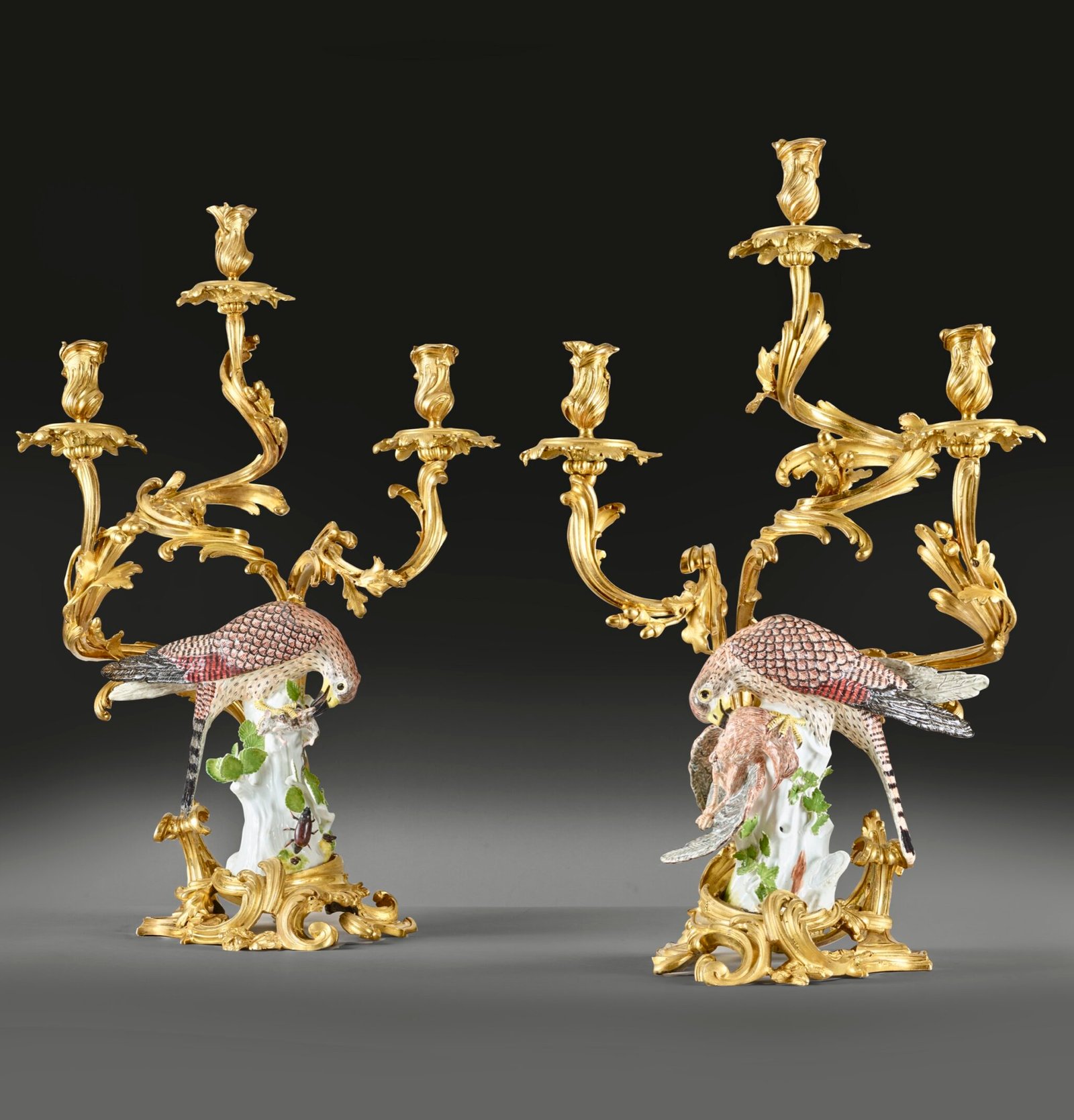
Probably supplied by Lazare Duvaux (circa 1703–1758)
Meissen porcelain after Johann Joachim Kändler (1706–1775),
models created in 1734 and 1739
Chased and gilt bronzes attributed to Jacques Caffieri (1678–1755) or Philippe Caffieri (1714–1774), circa 1745
Provenance: Genevan collection, from the 1970s to the present day
Height: 75 cm – 29 ½ inches
Width: 42 cm – 16 ½ inches
Depth: 36 cm – 14 ¼ inches
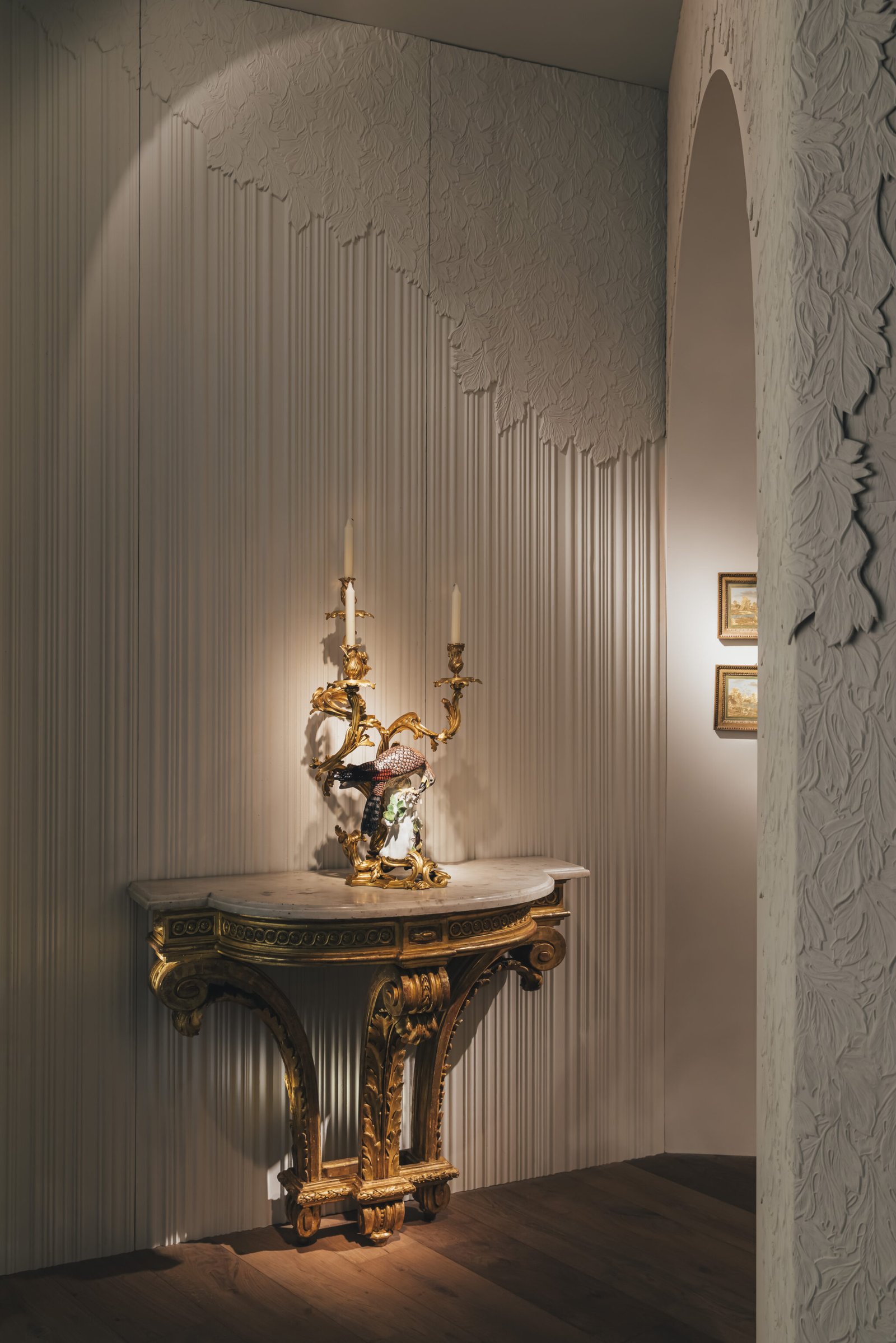
This exceptional pair of candelabra is a masterpiece of the rocaille taste. Combining superbly crafted gilt bronzes with celebrated sculpted porcelain groups from the Meissen manufactory, it is the work of an eminent marchand mercier.
MEISSEN BIRDS
In 1709, Saxony became the first European state to unlock the secret of hard-paste porcelain, through the research of the alchemist Johann Friedrich Böttger (1682–1719). A passionate collector of porcelain, the Elector of Saxony Augustus II the Strong then founded the Meissen manufactory, where Böttger continued his experiments. The manufactory’s painters and modelers initially drew inspiration from Asian pieces imported into Europe, adopting their forms and decorative vocabulary. The Elector placed his vast collection at the craftsmen’s disposal — he owned nearly 25,000 pieces by the late 1720s — to serve as a source of models.
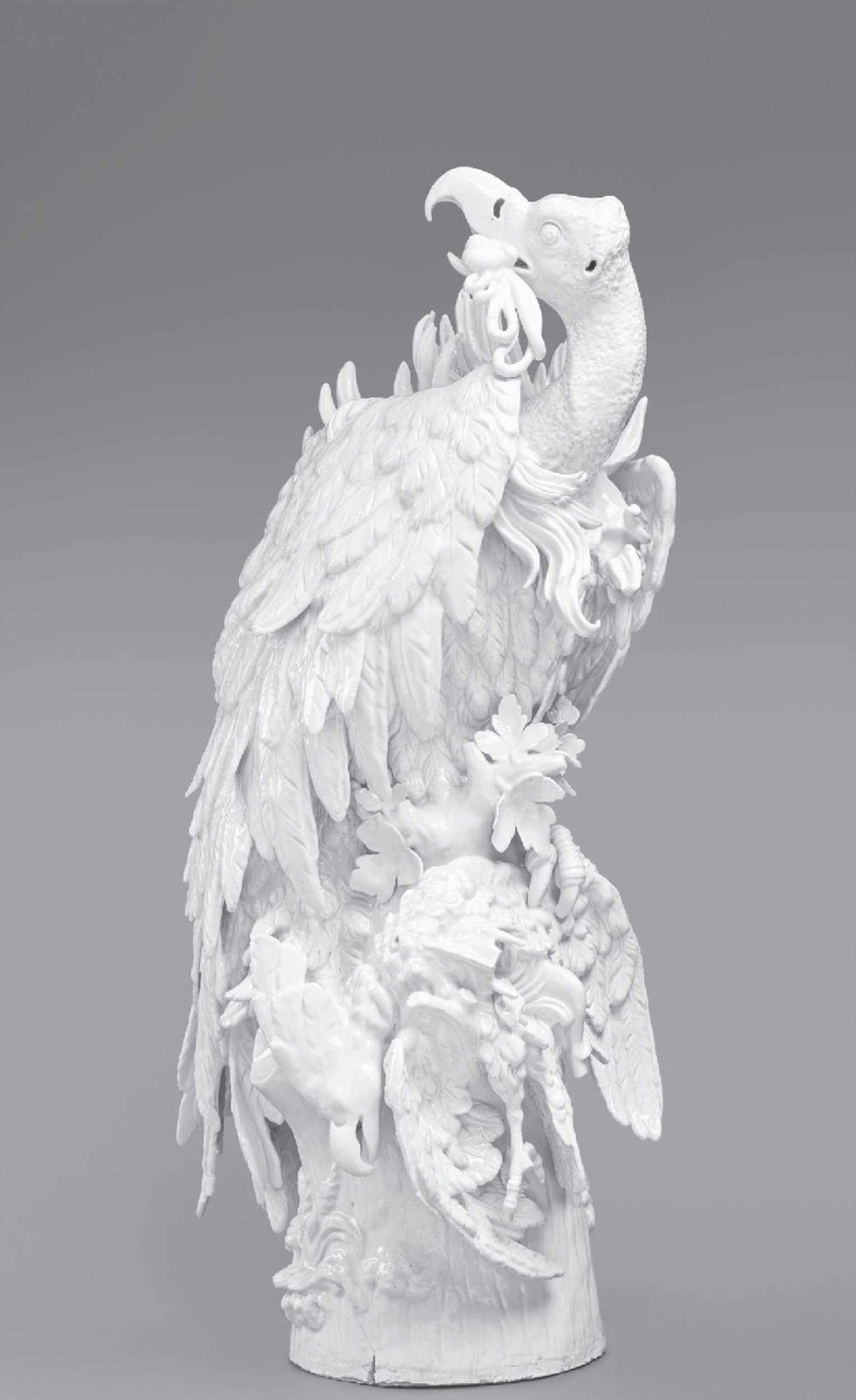
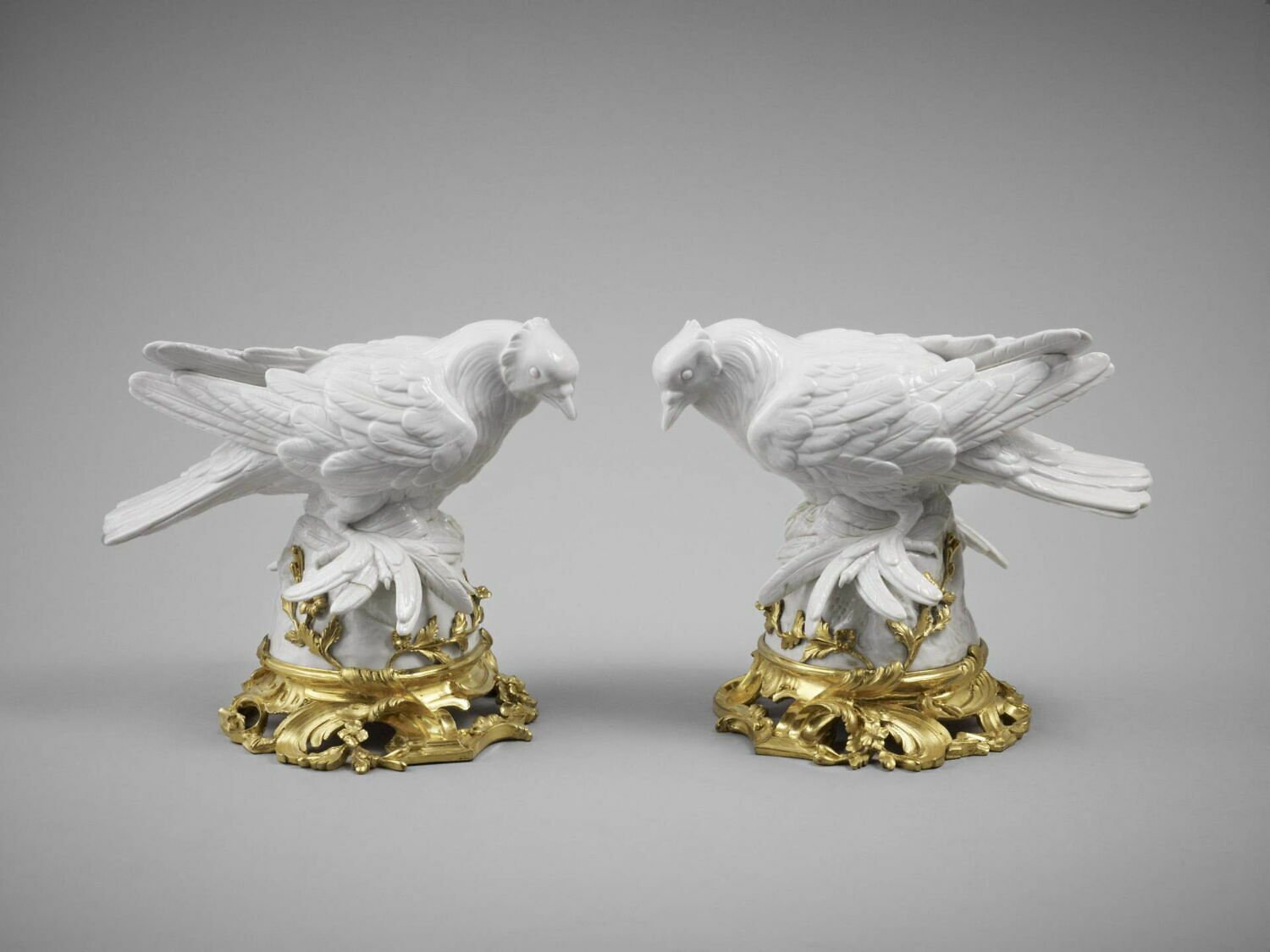
©RMN-Grand Palais Sèvres Cité de la céramique-Adrien Didierjean
In 1731, the sculptor Johann Joachim Kändler (1706–1775) joined the manufactory and gave it a decisive new direction. He was entrusted with the creation of life-size birds intended for the Japanese Palace that Augustus of Saxony was having remodeled in Dresden (Fig. 1). This particularly ambitious project posed a formidable challenge to the craftsmen, who had never before produced works of such scale. To sculpt his models, Kändler studied taxidermied specimens in the Kunstkammerof the Zwinger, which housed numerous exotic species brought back by the Saxon expedition to Africa (1731–1733). He also visited the menagerie at Schloss Moritzburg, where he observed live birds and carefully recorded their behavior. His work is distinguished by an exceptionally high degree of naturalism and an unrivaled precision in the dynamism of the poses and the rendering of surfaces.
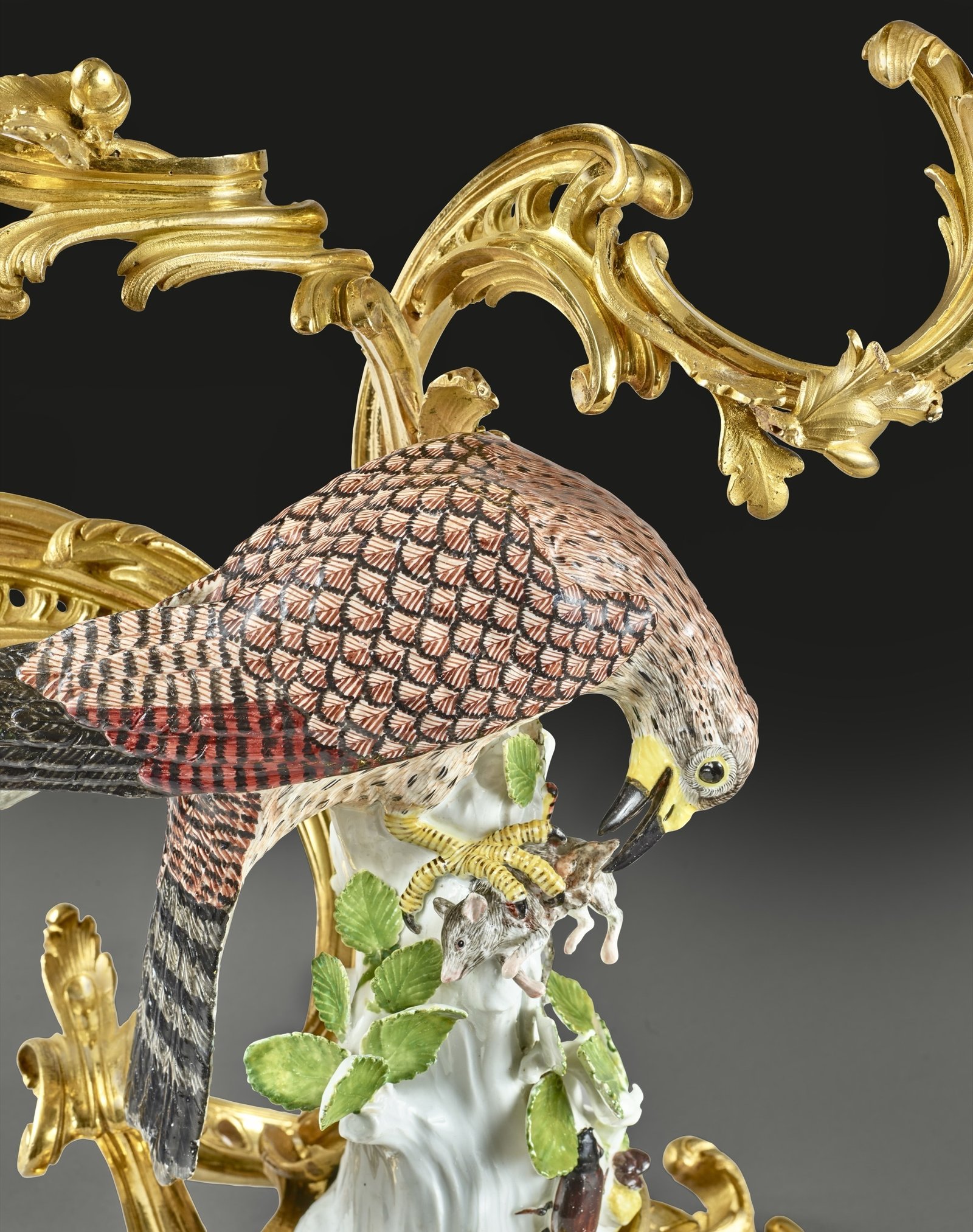
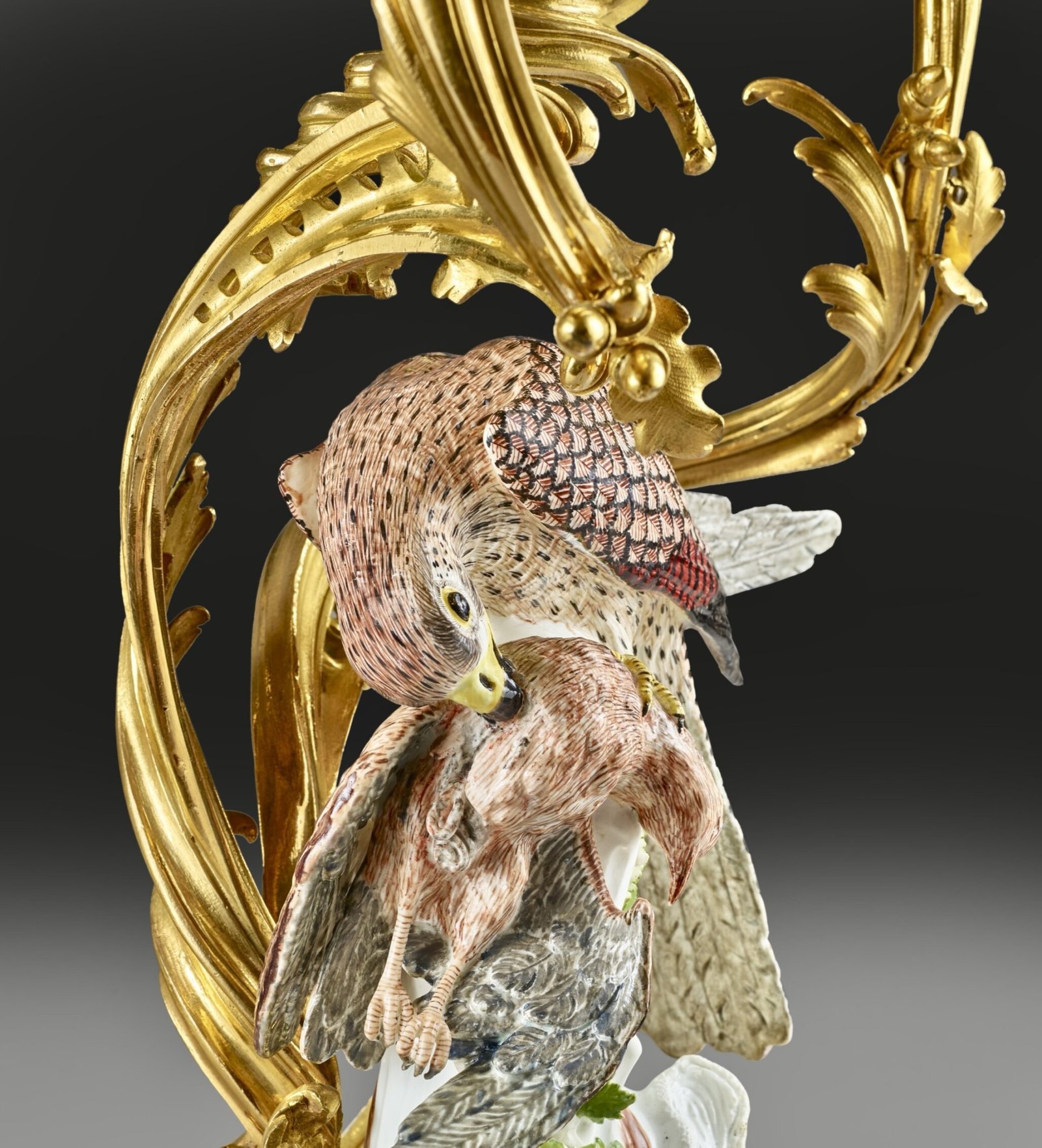
The sculptures are heightened with shimmering colors that further enhance the beauty of the pieces. The birds are depicted in attitudes characteristic of each species — hunting, feeding, perching. The falcons on our candelabra are thus shown pecking at their prey, held fast between their talons.
The “Female kestrel or lark hawk depicted life-size, as it devours a lark, resting on a decorated pedestal” is recorded for the first time in April 1734 in Kändler’s work reports. In October 1739, a closely related model was added to the series, depicting a falcon “seated on a tree stump, holding a mouse in its claws and devouring it.” (Fig. 2) Characteristic of Kändler’s talent, these groups radiate a remarkable spontaneity combined with genuine naturalistic precision.
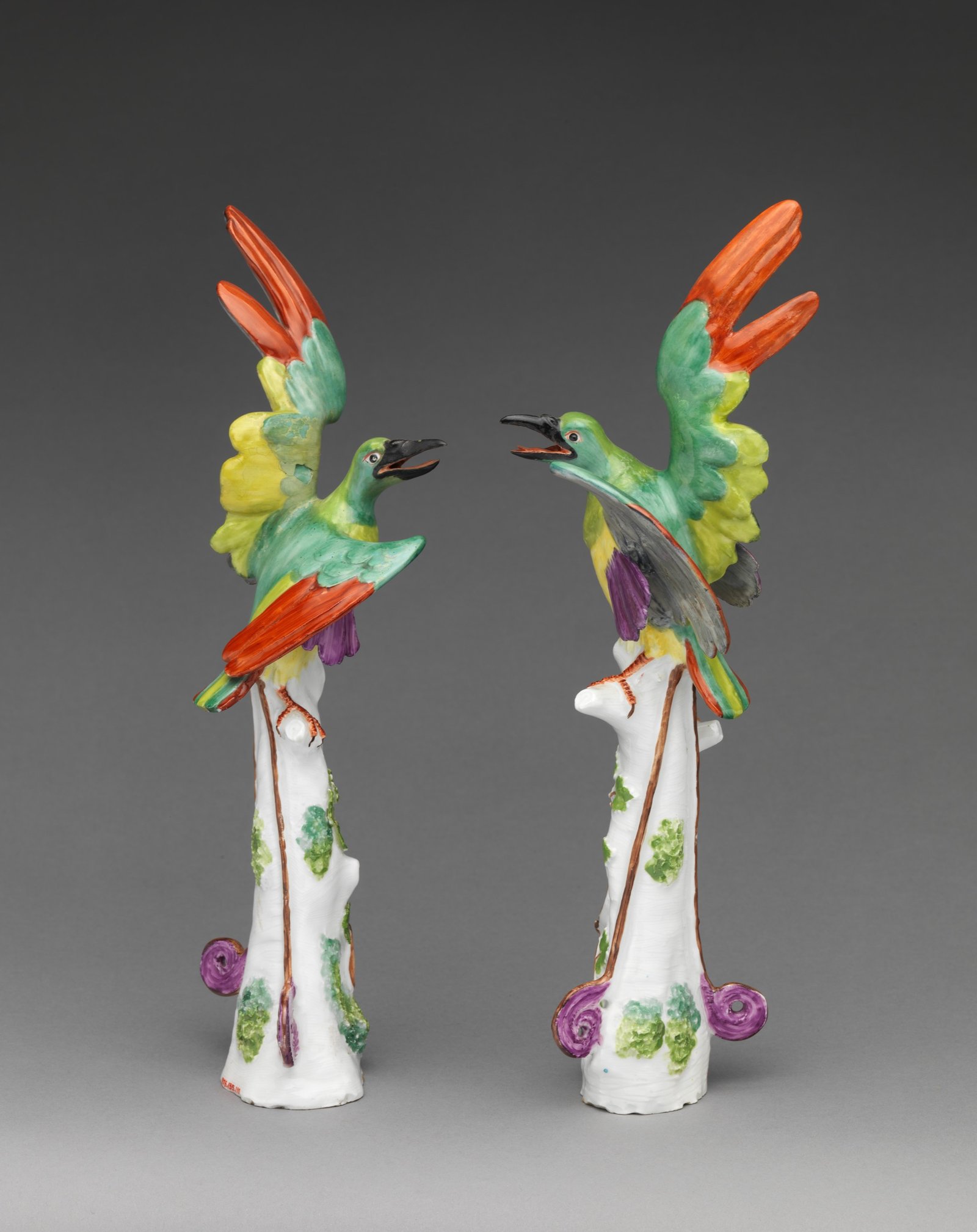
Several dozen bird models were produced by the sculptor in this manner (Fig. 3). Initially reserved for princely use, they were distributed more widely from the late 1730s onward. In Paris, they ranked among the most luxurious objects available, eagerly sought by the marchands merciers.
A MARCHAND MERCIER’S MASTERPIECE
The marchands merciers and the marchands faïenciers divided the porcelain trade between them in eighteenth-century Paris. Among the latter, Jean-Charles Huet and Henri Le Brun seem to have held a near-monopoly on porcelain imported from Saxony until the end of the 1730s. It subsequently appeared in the shops of the most prominent marchands merciers, notably Lazare Duvaux (c. 1703–1758) and Thomas-Joachim Hébert (1687–1773).
The statutes of the merciers’ guild authorized them to assemble and embellish a wide variety of materials, enabling them to devise entirely novel combinations of precious craftsmanship. Porcelain — the white gold of the eighteenth century — was among their most luxurious commodities. They acquired pieces imported from Asia or Saxony, as well as works from French manufactories, which they had mounted in gilt-bronze, incorporated into furniture, or fitted with sophisticated mechanisms (Fig. 4).
© 2011 Musée du Louvre, Dist. GrandPalaisRmn / Thierry Ollivier
Lazare Duvaux, one of the most brilliant marchands merciers of the reign of Louis XV, developed what he called girandoles montées sur porcelaine de Saxe — candelabra mounted on Saxon porcelain. Established on the rue Saint-Honoré under the sign of the Chagrin de Turquie, he produced objects and furniture of the highest luxury for the royal family and the high aristocracy.
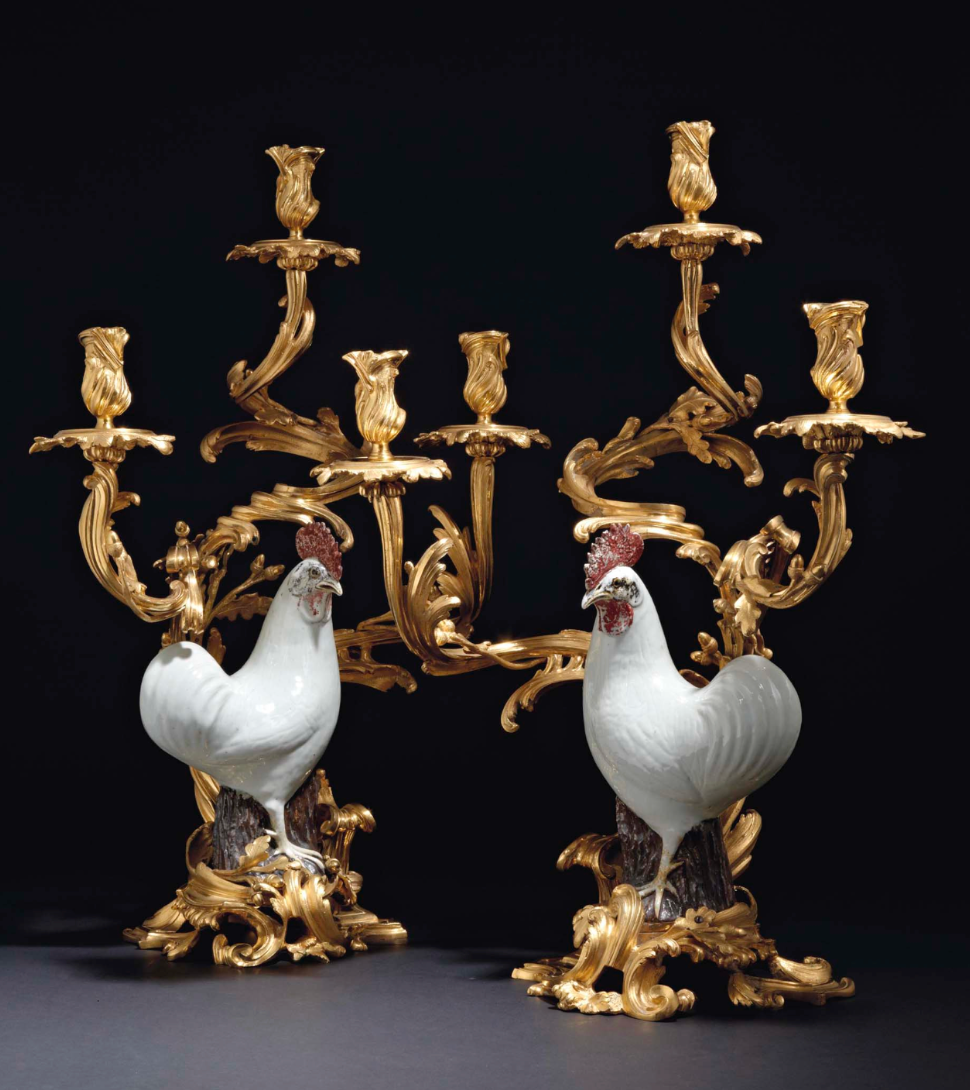
His Livre-Journal — the invaluable ledger documenting his trade from 1748 to 1758 — records several candelabra of this type, of which our pair in all likelihood formed a part. In November 1748, the ledger notes that the dealer delivered to the apartments of Mesdames at Versailles “four pairs of two-branch girandoles in Saxon porcelain and Vincennes flowers, on gilt mounts and branches; two pairs with figures and two with birds.” Further examples combining Saxon porcelain birds with gilt-bronze mounts are subsequently recorded, including rooster candelabra delivered to the Marquise de Pompadour, one of his most faithful clients, and to the collector Blondel de Gagny (Fig. 5). It was also in all likelihood Duvaux who delivered to the Duchess of Parma, daughter of Louis XV, six candelabra with porcelain birds.
Exceptionally luxurious and original, these Saxon porcelain bird candelabra were destined for the greatest collections of the eighteenth century, gracing the apartments of the royal family and those closest to the throne.
THE ROCAILLE ART OF THE CAFFIERI
Lazare Duvaux called upon the most skilled bronze makers to embellish his porcelains. The mounts of these candelabra — a masterpiece of the rocaille taste — are in all likelihood the work of Jacques (1678–1755) or Philippe (1714–1774) Caffieri.
The former was one of the most celebrated bronziers of the reign of Louis XV. Admitted as a master fondeur-ciseleur in 1715, he began working for the Crown as early as 1736, supplying furniture bronzes and decorative objects in a virtuosic rocaille taste. Trained in his father’s workshop, Philippe Caffieri entered into partnership with him in 1747. Their manner is distinguished by supple lines and powerful curves, underscored by chasing of incomparable fineness. The gilding, alternately matte and burnished, further deepens the modeled relief. They imparted a boldly sculptural character to their bronzes and displayed a richly inventive rocaille sensibility. Confident in their abilities, they count among the rare bronze makers to have occasionally signed their works.
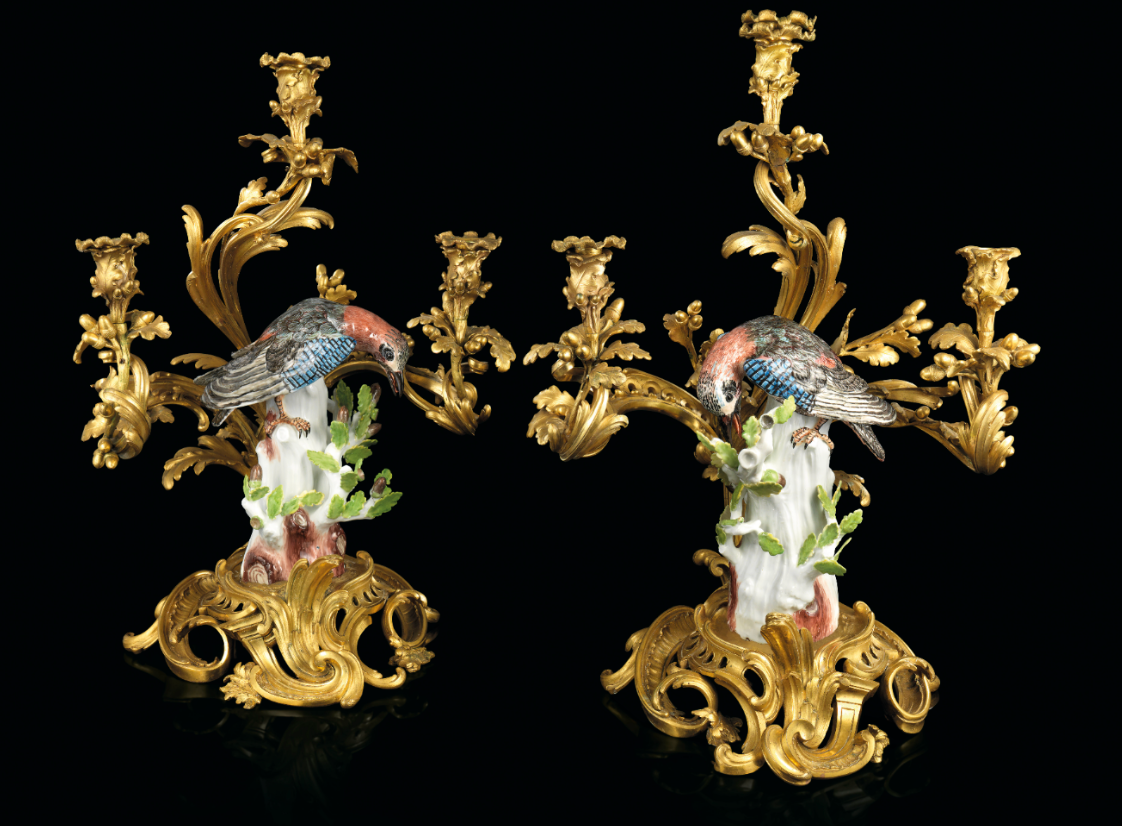
Although no direct relationship between the Caffieri and any marchand mercier has been documented to date, they in all likelihood collaborated on the production of several candelabra incorporating porcelain groups.
Two pairs said to have formed a diplomatic gift from Louis XV to the Borghese family, bearing the Caffieri hallmark, were acquired by Gustave de Rothschild (Fig. 6). Further examples, today held in private collections, are likewise attributed to them.
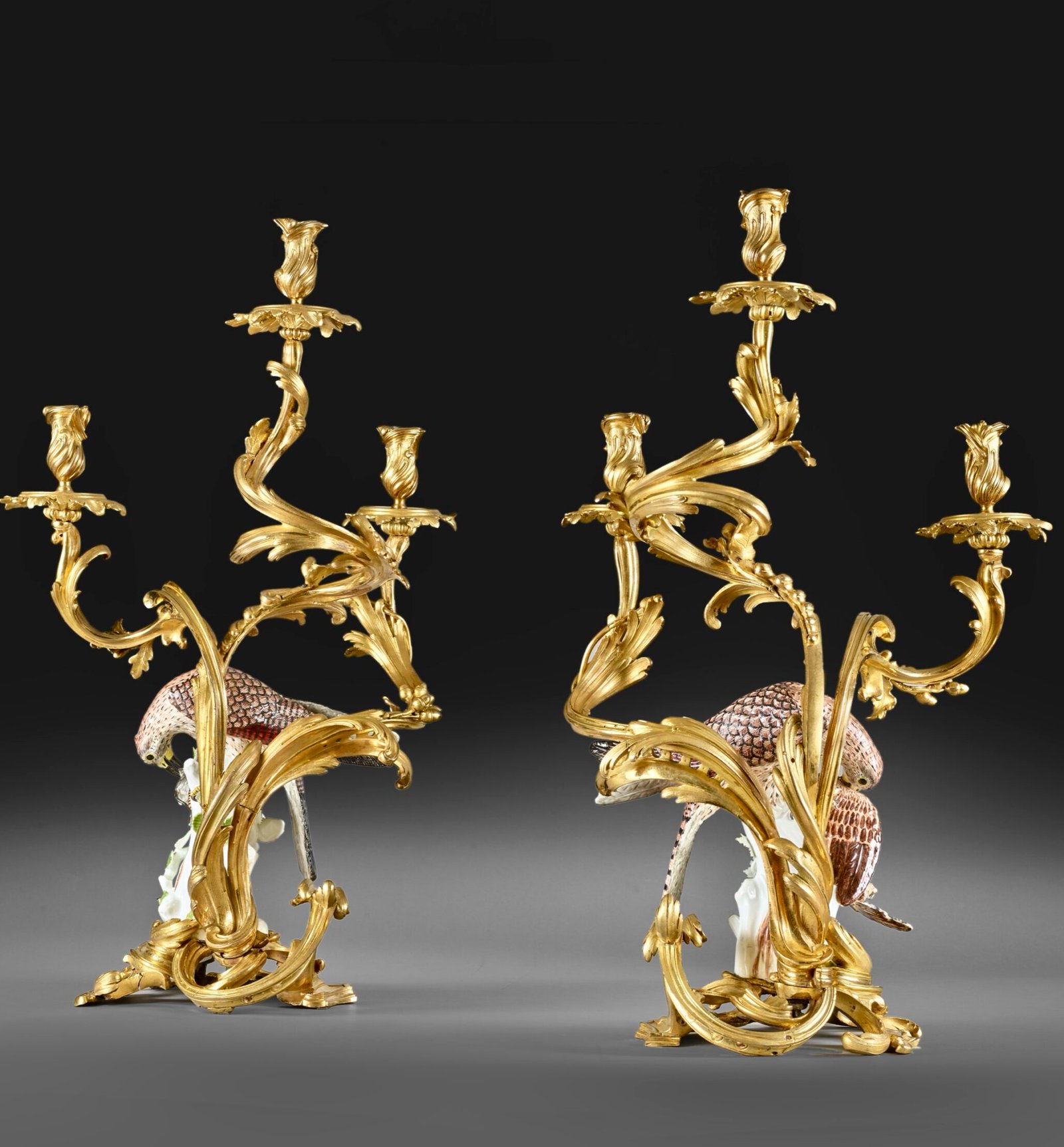
In our pair of candelabra, the dialogue between the porcelain and the bronzes is masterfully orchestrated (Fig. 7). The base is precisely fitted to receive the porcelain trunk with perfect elegance. The sweeping curves of the candle arms crown the sculpted group and follow its movement (Fig. 8). The ensemble, of extraordinary richness, unites Saxon porcelain and gilt bronze in remarkable harmony.
Bibliographie
Mathieu Deldicque, « La Saxe en or moulu, le goût pour les porcelaines de Meissen montées à la cour de Louis XV » dans Louis XV, passions d’un roi (1710−1774), Versailles, Domaine national du Château de Versailles et de Trianon, du 18 octobre 2022 au 19 février 2023, Paris, In Fine Éditions d’art, 2022, pp. 394–403.
Jules Guiffrey, Les Caffiéri, sculpteurs et fondeurs-ciseleurs : étude sur la statuaire et sur l’art du bronze en France au XVIIᵉ et au XVIIIᵉ siècle, avec sept gravures à l’eau-forte de Maurice Leloir, Paris, D. Morgand & C. Fatout, 1877 ; rééd. fac-similé, Nogent-le-Roi, J. Laget, 1993.
Lazare Duvaux, Livre-journal de Lazare Duvaux […]. Tome 2 [publié par M. Louis Courajod], Société des bibliophiles français, Paris, 1873. Gerhard Röbbig, Cabinet Pieces: The Meissen Porcelain Birds of Johann Joachim Kändler, Munich, Hirmer Publishers.

