
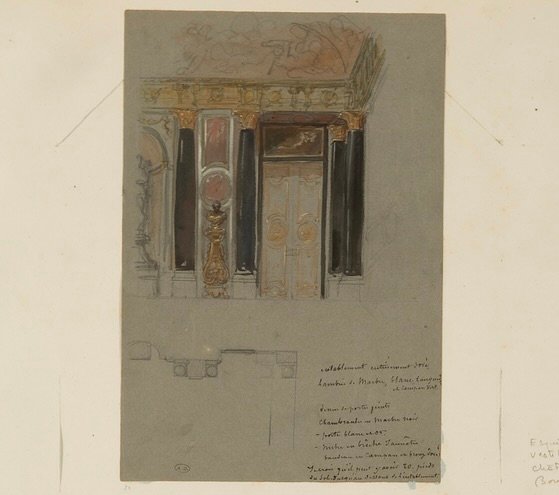
© Les Arts Décoratifs / Jean Tholance
A painter, decorator, and art agent, Eugène Lami was one of the leading artistic figures of the 19th century. In the service of the Orléans and the Rothschild families, he contributed to the revival of interest in 18th-century decorative arts.
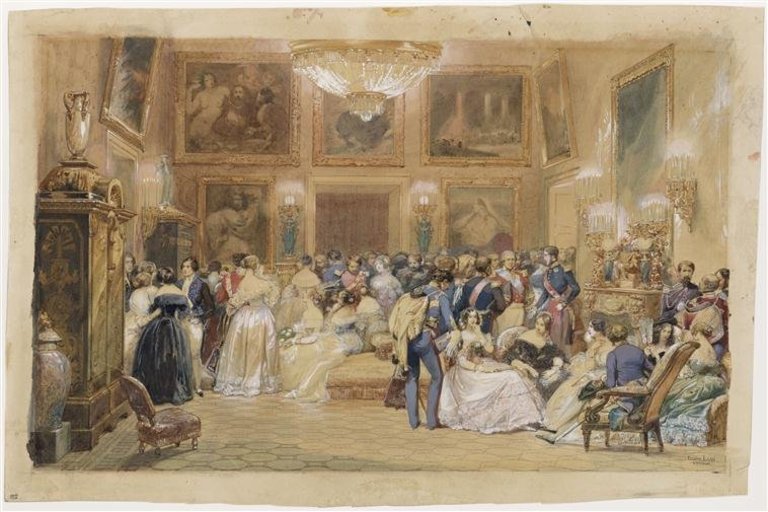
RF 55315)
© GrandPalaisRmn (Musée du Louvre) / Michel Urtado
Born in Paris, Lami studied painting at the École des Beaux-Arts under the history painter Horace Vernet (1789–1863) before joining the studio of Baron Gros. In addition to painting, he trained in lithography and watercolor, the latter becoming one of his preferred techniques. Between 1825 and 1829, Lami traveled to England, where he completed his artistic education through the discovery of country houses and their interiors. Upon his return to France, his military scenes attracted the attention of Louis-Philippe, who appointed him his official painter as early as 1832. Lami subsequently grew close to the royal family: the king commissioned several works from him for the Museum of the History of France at the Château de Versailles and appointed him drawing instructor to his children. Through his lively watercolors, Lami documented the social life and official ceremonies of the July Monarchy, prompting Baudelaire to describe him as a “poet of official dandyism.”
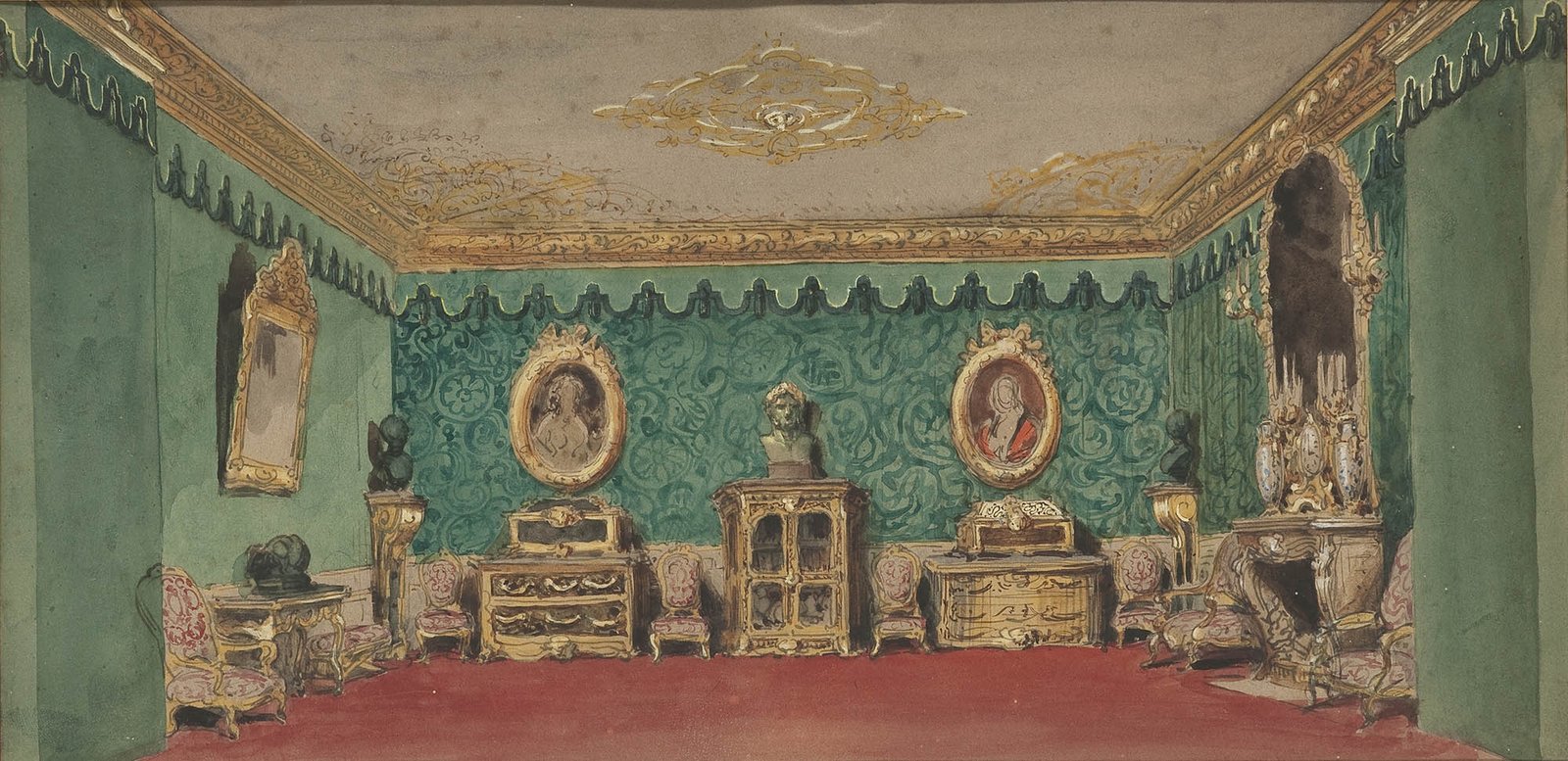
© Les Arts Décoratifs / Jean Tholance
In 1844, Lami was entrusted with the redesign of the apartments of the Ducs de Nemours and d’Aumale, sons of Louis-Philippe, at the Tuileries Palace. With access to Garde-Meuble de la Couronne and the Versailles collection, he promotes a return to the 18th century. Won over by his work, the Duc d’Aumale asked him that same year to design the interiors of his own apartments and those of his wife at the Château de Chantilly. Echoing the Orléans legacy and the history of the château, Lami combined 18th-century furniture and objets d’art with contemporary reproductions, set within paneled rooms featuring white-and-gilt boiseries with rocaille moldings. For the Salon des Dames, he selected armchairs supplied by Georges Jacob (1739–1814) for the King’s Salon des Jeux at Saint-Cloud in 1787, as well as a Louis XVI clock by André Hessen (1745–1805), paired with contemporary reinterpretations of the Louis XV and Louis XVI styles. In doing so, Lami created one of the earliest historicist interiors inspired by the 18th century, inaugurating a taste that would later reach its height in the interiors of Empress Eugénie.
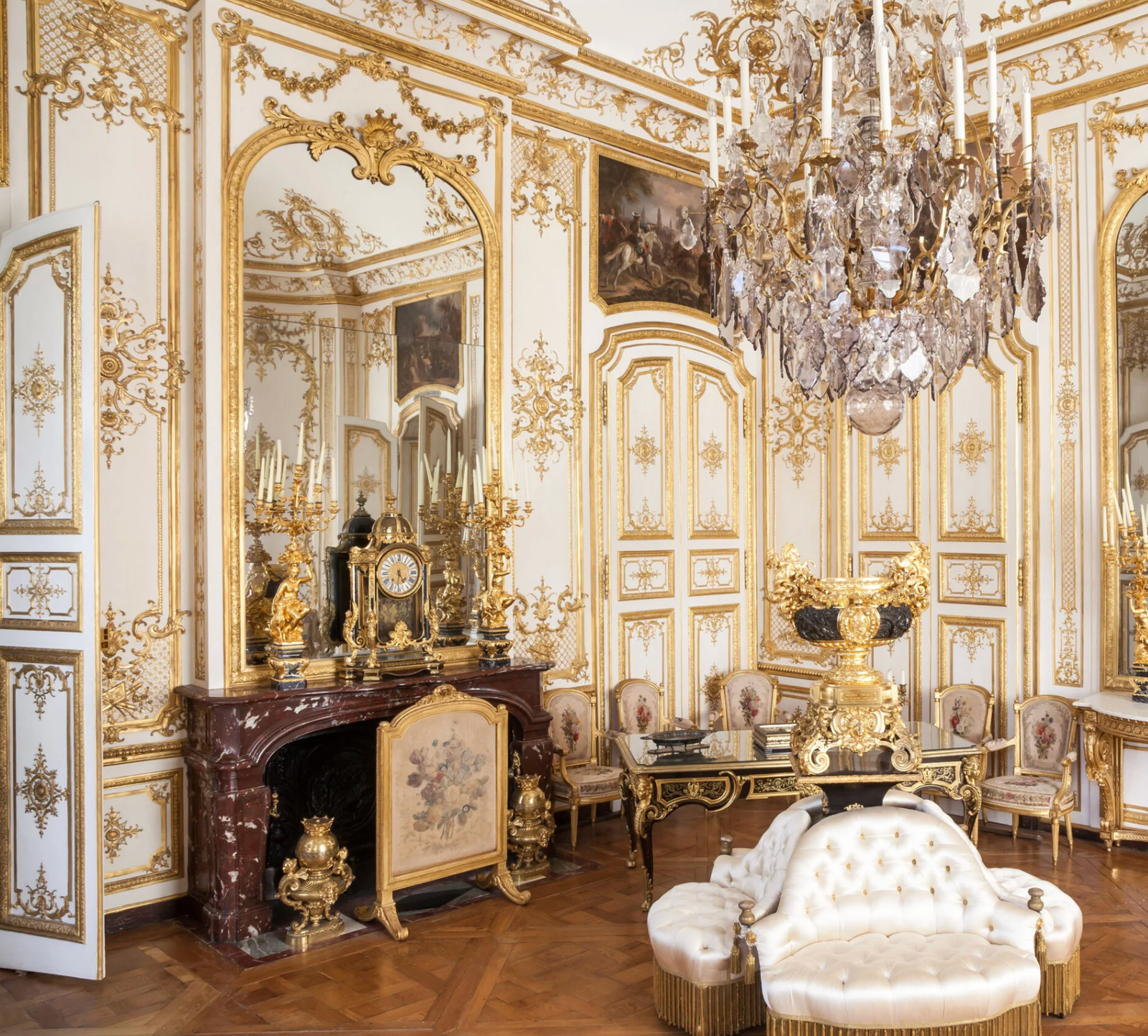
This room combines 18th-century furniture and objets d’art—notably a Louis XIV-style cartel clock with Boulle marquetry acquired by Eugène Lami in August 1846 from the Parisian antique dealer Gansberg (inv. OA 303)—with period-style furnishings.
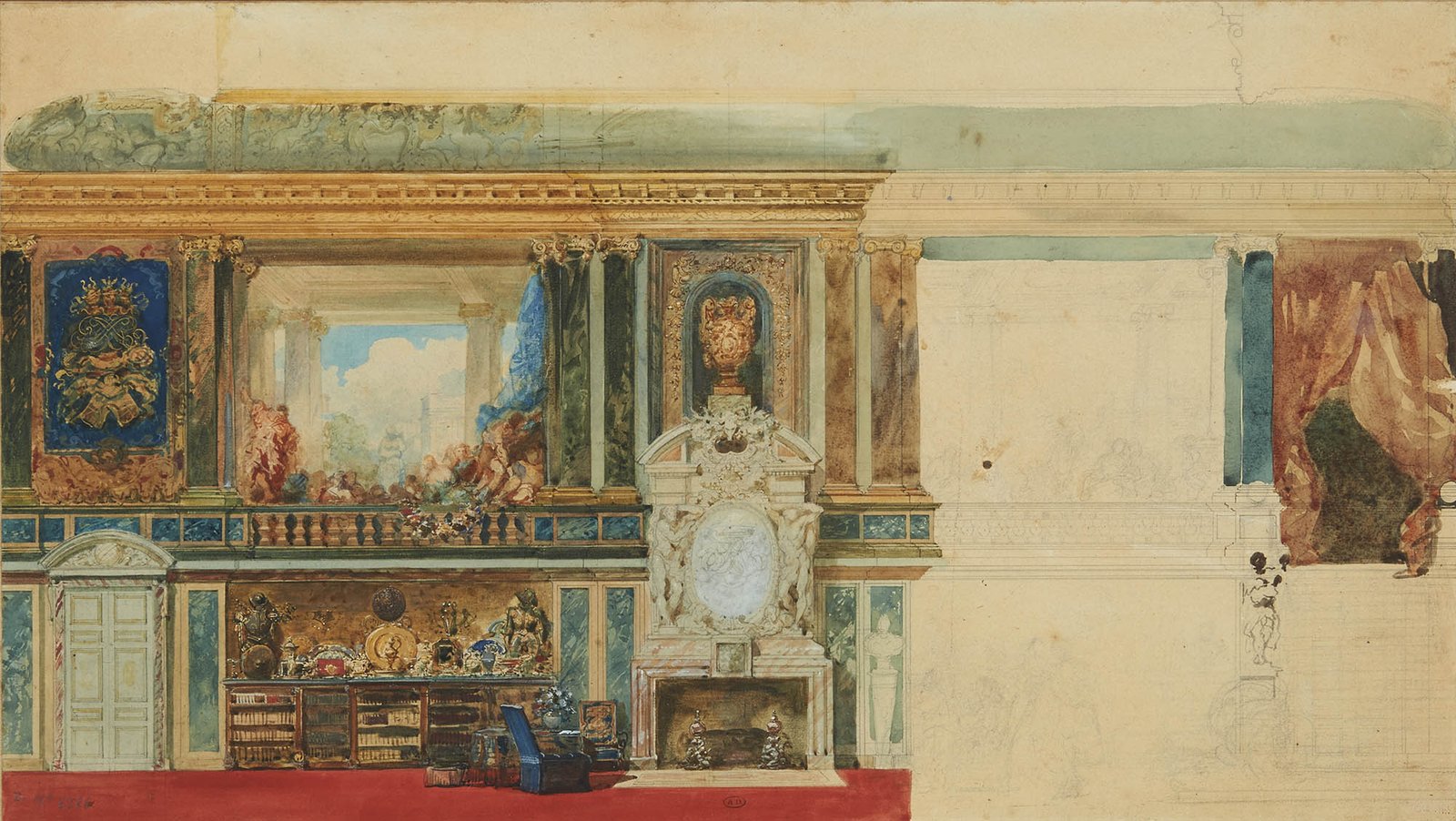
Circa 1852, Lami met Baron James and Baroness Betty de Rothschild. From that point on, he devoted his talents exclusively to the Rothschild family, cultivating close and trusting relationships with them. The « great favorite » of Betty, he stayed for extended periods with Adolphe de Rothschild in 1870 and was also close to his brother Gustave. Lami first worked on James’s château in Boulogne, for which he devised an interior scheme largely inspired by the Versailles of Louis XIV, particularly the arabesque designs of Jean Bérain (1640–1711). From 1857 onward, he devoted himself to the Château de Ferrières, his masterwork. There, he created an ideal setting for the baron’s collections, favoring an eclectic taste that combined periods and colors. The 18th century remained central, with the Versailles of the Sun King as one of his primary references. Combined with Renaissance and Baroque elements, it came to embody the true “Rothschild taste.”
© Les Arts Décoratifs / Cyrille Bernard
A prolific creator with a deep antiquarian knowledge, Lami was one of the first modern decorators. For the Duc d’Aumale and later for the Rothschilds, he developed a historicist approach to interiors, notably privileging the 18th century. Producing numerous sketches for his projects, he designed both the architectural framework and the furnishings of his clients’ residences, down to the details of upholstery. With a refined eye, he sourced furniture and works of art across France and Europe to complete his interiors and enhance the presentation of his clients’ collections. For Chantilly, he acquired numerous 18th-century pieces from Parisian dealers such as Escudier and Gansberg. With Betty de Rothschild, he traveled to Italy, drawing inspiration from Venetian palaces. Coordinating the various craftsmen involved in his projects, he also recommended artists from his circle, including Narcisse Diaz (1807–1876) and Édouard Dubufe (1819–1883). In this way, Eugène Lami achieved a total work of art for the Duc d’Aumale and the Rothschilds, acting simultaneously as technician, artistic director, and stage designer.
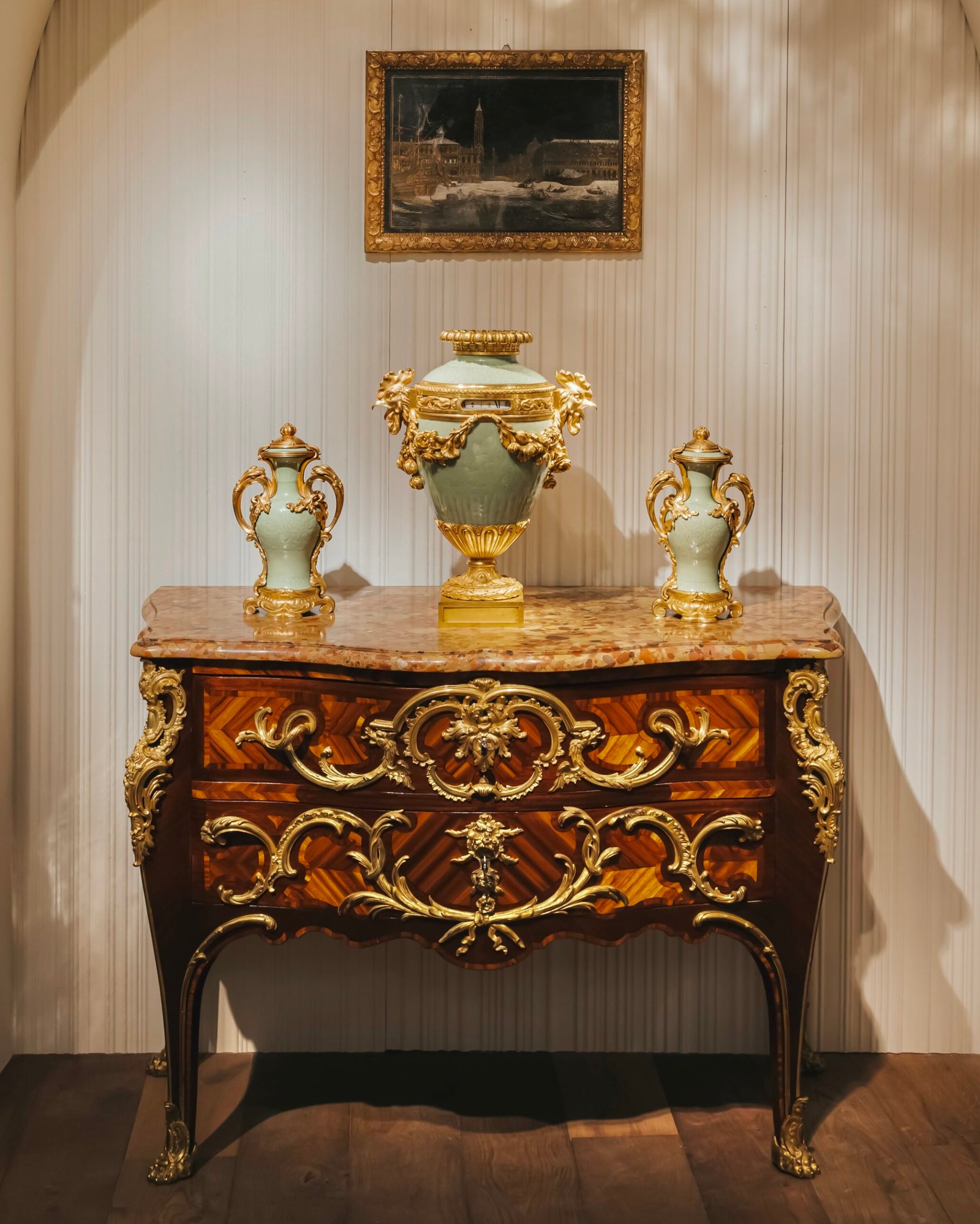
From the collection of Baron Gustave de Rothschild, and subsequently passed down to his son Robert and his grandson Alain de Rothschild.
On display from April 17 to July 26 at the Galerie des Gobelins,
as part of the exhibition “Sèvres, a Rothschild Passion.”
One of the principal pioneers of both the historicist taste for the 18th century and the Rothschild aesthetic, Lami remains a key creative figure in the legacy of Enlightenment decorative arts.
His work is currently being celebrated from April 17 to July 26 at the Galerie des Gobelins in the exhibition “Sèvres: A Rothschild Passion.” A commode from our collection, formerly owned by Gustave de Rothschild—for whom Lami worked on rue de Marigny—will be on display.
Bibliography:
Anne Forray-Carlier, Le mobilier du château de Chantilly, Éditions Faton, 2010
Aurore Bayle-Loudet, Mathieu Deldicque, Chantilly, le domaine des princes, Swan éditeur, 2017
Pauline Prévos-Marcilhacy, Les Rothschild, bâtisseurs et mécènes, Flammarion, 1995
Anne-Dion-Tennebaum, Audrey Gay-Mazuel, Revivals, l’historicisme dans les arts décoratifs français au XIXe siècle, MAD Paris, 2020
Audrey Gay-Mazuel, “Eugène Lami, premier décorateur moderne”, L’Objet d’artn°598, mars 2023, p 64–71

