
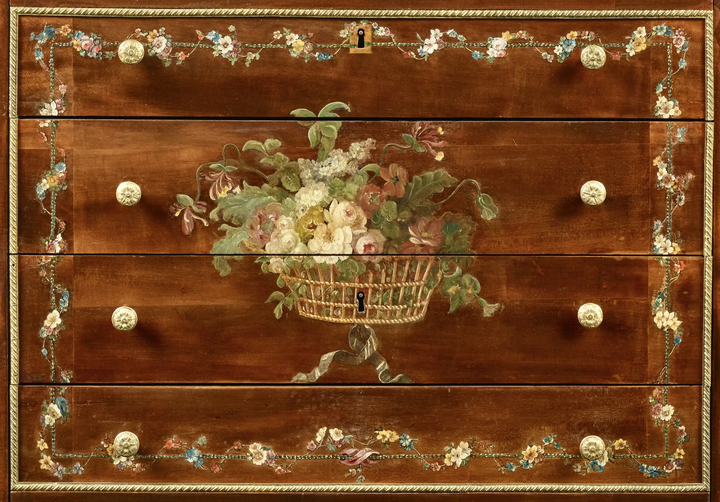
Ferdinand Bury (cabinetmaking attributed to), Jean-Louis Prévost (painted decoration attributed to), Jean-Baptiste II Tuart (probably delivered by), Low cabinet, from a pair, detail, circa 1770–1775, Galerie Léage, formerly in the collection of Hannah Primerose, née Rothschild, at Mentmore Towers
In the second half of the eighteenth century, Parisian makers and dealers competed in inventiveness, creating furniture that was both original and at the forefront of taste. Among these productions, furniture painted in oil on sycamore maple veneer stands out as exceptionally rare and refined.
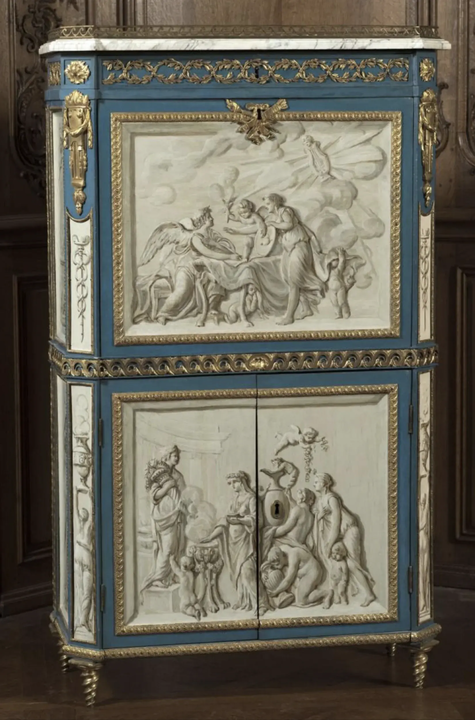
René Dubois (cabinetmaking attributed to), Secretary, circa 1770–1780, Paris, Petit Palais — Musée des Beaux-Arts de la ville de Paris (inv. ODUT1506)
A taste for richly colored furniture had been evident among Parisian collectors since the 1730s, following the popularization of European lacquer decoration by the Martin brothers. In the 1770s this enthusiasm intensified, and several cabinetmakers developed original decorative schemes using a variety of techniques. René Dubois (1737–1799) adorned his pieces with superb camaïeu decorations or reproductions of easel paintings enhanced with vivid colors. Jean-Henri Riesener (1734–1806), for his part, had rich arabesques painted under glass for the doors of a cabinet delivered to the Comte d’Orsay around 1770 (Musée du Louvre, inv. OA 6523). Philippe Pasquier (master in 1760) followed their example for a secrétaire made for Madame du Barry, favorite of Louis XV (Metropolitan Museum, inv. 58.75.120): its fall-front and the fronts of the interior drawers are decorated with various scenes in gouache, pastel, and watercolor placed under glass. Within this varied production, a rare group of pieces painted in oil on sycamore maple veneer distinguishes itself.
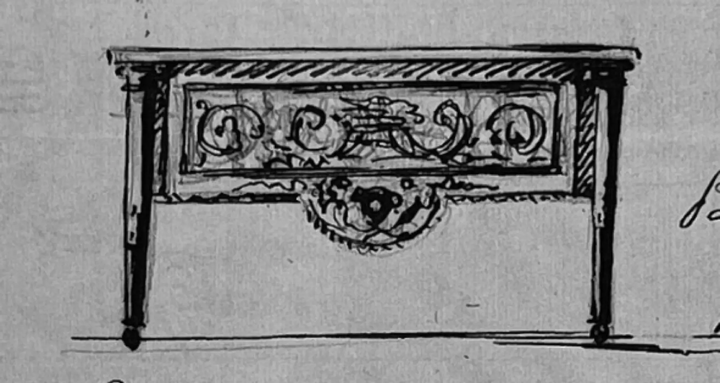
Étienne-Louis Boullée, Design for a chest of drawers, circa 1770–1780, Paris, École nationale supérieure des beaux-arts (inv. no. O1084)
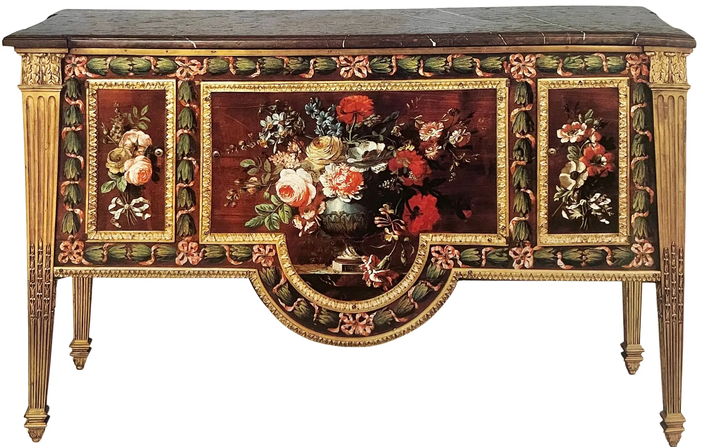
Joseph Baumhauer (cabinetmaking), Jean-Louis Prévost (painted decoration), Chest of drawers, delivered to Nicolas Beaujon at the Hôtel d’Évreux, circa 1770, Rome, Terruzzi Collection
In 1773 Nicolas Beaujon, banker to the King and the Court, acquired the Hôtel d’Évreux — former residence of Madame de Pompadour and today the Palais de l’Élysée. He entrusted its refurbishment to the architect Étienne-Louis Boullée (1728–1799), who appears to have overseen both the architectural works and the interior decoration. The idea for particularly original furniture seems to have emerged at this moment, whether at the initiative of Beaujon or his architect. Satin-grained sycamore maple veneer, delicately painted in oil with floral motifs, was selected for several pieces, including a chest of drawers and two secrétaires en armoire. A drawing by Boullée defines the general silhouette of the chest of drawers, still known today and preserved in Rome in the Terruzzi Collection. Stamped by the cabinetmaker Joseph Baumhauer (1747–1772), it was oil painted by Jean-Louis Prévost (1740–1810), a painter of still lifes. One of the secrétaires from this ensemble is probably the example now preserved at Waddesdon Manor.
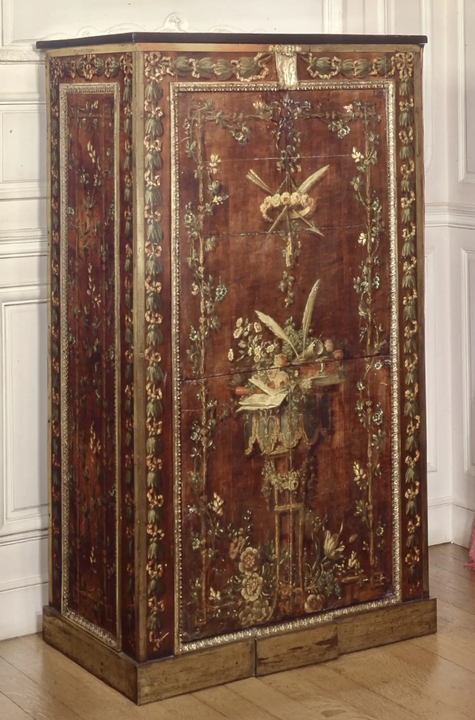
Joseph Baumhauer (cabinetmaking attributed to), Louis-Étienne Boullée (possibly after a design by), Jean-Louis Prévost (possibly painted by), Fall-front desk, probably delivered for Nicolas Beaujon to the Hôtel d’Évreux, circa 1770, Aylesbury, Waddesdon Manor (inv. 3160)
The fashion for furniture painted on sycamore maple veneer was thus launched in Paris. Other dealers adopted the idea, notably the marchand-ébéniste Jean-Baptiste II Tuart (Master in 1752). A coordinator — whether merchant or architect — was essential to the creation of these works, which required the collaboration of a cabinetmaker and a painter, further enriched with gilt-bronze mounts and marble tops. Tuart commissioned Ferdinand Bury (1740–1795) to create a chiffonnier now in a private collection bearing both their stamps. A few other rare examples are known, including two pairs of cabinets from Mentmore Towers, a demi-lune chest of drawers stamped by Jacques-Laurent Cosson (Master in 1765), a pair of low cupboards in private hands, and a pair of Consulate-period consoles now in the collections of the Banque de France. Executed around 1800, the latter mark the end of this highly limited production, which can be reduced to scarcely more than a dozen recorded examples.
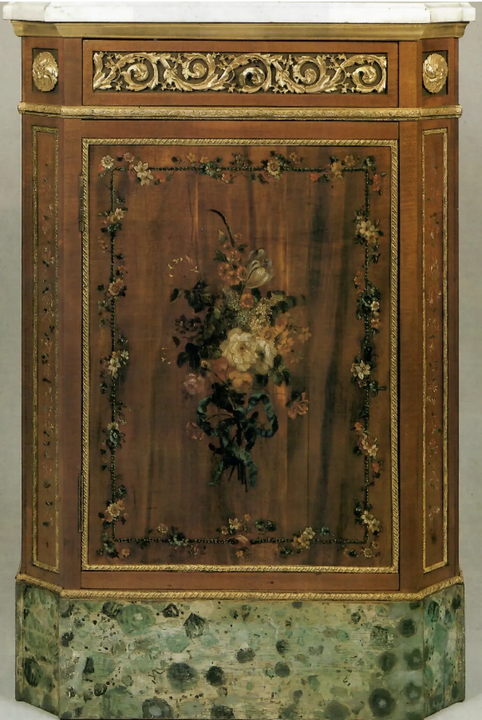
Cabinet, from a pair, circa 1770–1775, formerly in the collection of Hannah Primerose, née Rothschild, at Mentmore Towers
These pieces offer an original interpretation of the neoclassical aesthetic. Their often strictly geometric forms reveal the rigor and clarity of line characteristic of the period. Their decoration recalls the arabesques and delicate floral motifs found on contemporary textiles and porcelains. They were clearly conceived to harmonize with similarly ornamented paneling schemes. At the Palais Bourbon, the Prince de Condé owned a boudoir painted by Deleuze in imitation of tulipwood and porcelain tiles decorated with flowers, furnished with a secrétaire painted to echo those same motifs. Likewise, a set of arabesque-decorated paneling from the Folie Beaujon — a pavilion built by the financier in the Faubourg du Roule — may be compared with the surviving chest of drawers and secrétaire, where the same garlands of flowers and compositions arranged in large blue vases appear.
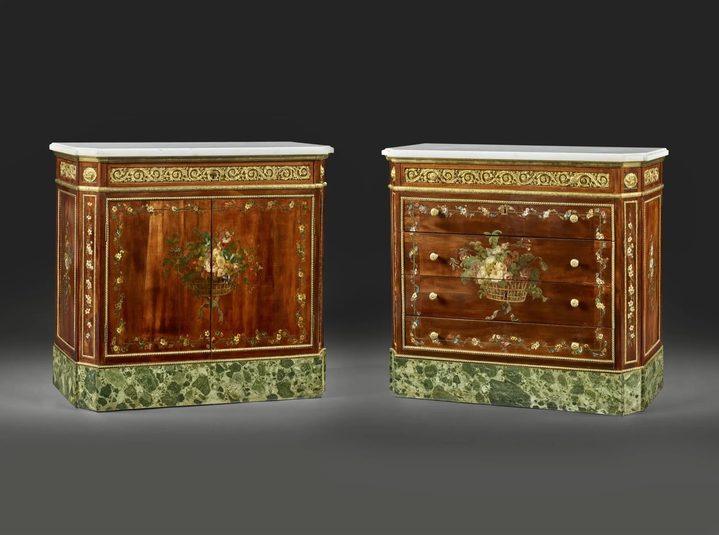
Ferdinand Bury (cabinetmaking attributed to), Jean-Louis Prévost (painted decoration attributed to), Jean-Baptiste II Tuart (probably delivered by), Pair of low cabinets, circa 1770–1775, Galerie Léage, former collection of Hannah Primerose, née Rothschild, at Mentmore Towers
Rare since the moment of their creation, these pieces rank today among the most exceptional survivals of Parisian decorative refinement in the 1770s. Galerie Léage will present two cabinets from this remarkable group at its stand at TEFAF Maastricht, offering a remarkable opportunity to rediscover this distinctive and highly refined production.
Bibliography:
Catalogue collection, 18e. Aux sources du design, Éditions Faton, 2014
B. G. B. Pallot, « Les meubles peints sur fond d’érable sycomore », Connaissance des Arts, février 1987, pp. 98–107.

